PART 3
I was surprised by her reaction.
I had expected her to congratulate us. Maybe she would even offer to help us find old furniture or tell us stories about the neighborhood.
Instead, she seemed almost frightened.
“Opal, is something wrong?”
She looked toward the road to make sure nobody was coming.
“Tell me something, sweetheart. When you and Nate bought this property, did anyone mention the old Miller family?”
“No. The county auction clerk said the house had been abandoned for six years. Why?”
Opal closed her eyes briefly.
“Because this property has a history, and your father-in-law knows more about it than he’s ever told you.”
I followed her inside.
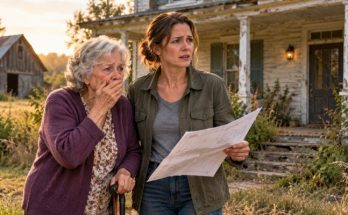
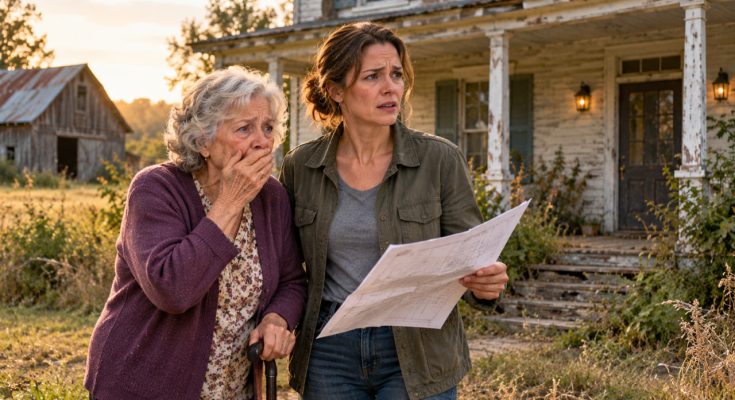
The house smelled of dust, damp wood, and the faint sweetness of old cedar. Nate had already replaced several floorboards and removed the ruined carpeting from the living room. A few tools lay beside the fireplace, and a stack of salvaged lumber rested against the wall.
Opal moved slowly through the room, touching the doorframe, the windowsill, and finally the mantel above the fireplace.
“This house was once beautiful,” she murmured.
“Did you know the Millers?”
“I knew Mrs. Miller. Her name was Eleanor. She was a kind woman who worked harder than anyone I ever met.”
Opal settled into the chair Nate had brought from our old apartment.
“Her husband died young. She raised two children here, worked at the school cafeteria, and grew vegetables to sell at the farmers’ market. When times were hard, she never complained.”
She paused and looked at me.
“People like Eleanor understand what it means to build a life with your own hands.”
I sat across from her.
“Why did you ask whether Ronald knew we’d bought the property?”
Opal’s expression changed.
“Because twenty years ago, your father-in-law had an opportunity to buy this same house.”
I blinked.
“What?”
“Ronald was younger then. He and Judy had three children, a mortgage, and more expenses than they knew what to do with. Eleanor was struggling to keep up with the property taxes after her husband died. She offered to sell the place to Ronald at a price he could afford.”
“Did he buy it?”
“No.”
“Why not?”
Opal looked down at her hands.
“Because he believed the property was worthless. He said the house was too old, the land was inconvenient, and the barn would cost too much to repair. Eleanor offered him a generous arrangement, but he refused.”
She looked around the room.
“Someone else eventually bought a portion of the surrounding farmland, but this house remained in Eleanor’s family until her estate became tangled in unpaid taxes and legal expenses.”
I frowned.
“That explains the auction, but what does Ronald have to do with it now?”
“Before Eleanor died, she told me something. She said she had hidden a document in this house. A document that might explain why Ronald never wanted anyone in the family to take an interest in this property.”
My heart began to beat faster.
“What kind of document?”
“I don’t know exactly. Eleanor wouldn’t tell me where she put it. She only said that one day, someone would come along who understood the difference between being given something and earning it.”
I stared at her.
“Do you think she meant us?”
“I think it’s worth finding out.”
Just then, the sound of a truck engine came from the driveway.
Opal’s face went pale.
I hurried to the window.
A dark pickup had stopped outside. Nate was climbing down from the driver’s side, carrying a toolbox.
Behind him, another vehicle pulled into the yard.
It was Ronald’s truck.
I turned toward Opal.
“You said not to tell him.”
“I didn’t tell him,” she whispered.
Outside, Nate greeted his father, apparently surprised by the unexpected visit.
Ronald said something I couldn’t hear, then pointed toward the house.
A moment later, both men started toward the porch.
Opal gripped my wrist.
“Listen carefully,” she said. “Whatever happens today, don’t let Ronald convince you that you owe him anything.”
Before I could respond, the front door opened.
Nate stepped inside first.
“Dad says he heard about the auction,” he explained. “Apparently, somebody at the courthouse recognized our name.”
Ronald followed him into the living room.
His eyes swept across the stripped walls, the exposed floorboards, and the pile of electrical supplies.
Then he laughed.
“Well, I’ll give you two credit for being ambitious.”
Nate’s jaw tightened.
“What are you doing here, Dad?”
Ronald ignored the question and walked toward the fireplace.
“I came to see what you’ve gotten yourselves into. This place has been a money pit for years. You could spend twice what you paid and still end up with a house nobody wants.”
“We’re not planning to sell it,” I said.
“Everyone says that at first.”
He ran a finger across the mantel, examining the dust.
Then he turned toward Opal.
“Grandma, I didn’t realize you were here.”
“Clearly,” she replied.
Ronald forced a smile.
“What brings you out to this old place?”
“I wanted to see what my grandson and his wife had accomplished.”
“Well, you’ve seen it.” He gestured toward the damaged walls. “They’ve bought themselves a problem.”
Nate put down his toolbox.
“It’s our problem, Dad. We’ll handle it.”
Ronald’s expression hardened.
“I hope you understand what you’re doing. A property like this can swallow every dollar you have.”
“We understand.”
“And if you run short of money, don’t expect us to rescue you.”
The words hung in the air.
For a moment, I was back at Easter dinner, staring into that bluebird card while three envelopes containing $20,000 each sat in the hands of Nate’s siblings.
Nate remembered it, too.
He looked at his father and answered quietly.
“We wouldn’t ask you to.”
Ronald appeared satisfied.
“Good. Independence is a wonderful thing when you can afford it.”
Opal struck the floor with her cane.
“That’s enough, Ronald.”
He turned toward her.
“What?”
“You heard him. They aren’t asking you for anything. So stop talking to them as if they’re children who need your permission to live their own lives.”
Ronald’s cheeks reddened.
“I was only offering advice.”
“No,” Opal said. “You were reminding them that you didn’t help.”
Silence filled the room.
Ronald glanced at me, then at Nate.
Finally, he straightened his jacket.
“Fine. Do whatever you want. Just don’t come crying to us when this place falls apart.”
He walked out.
Through the window, I watched him climb into his truck and reverse down the driveway.
Nate stood perfectly still until the engine disappeared.
Then he exhaled.
“I’ve spent my entire life trying to prove to that man that I’m capable of doing something on my own.”
Opal reached for his hand.
“You don’t have to prove it anymore.”
He looked at her.
“What did you mean earlier, Grandma? What did you and my dad have to do with this property?”
Opal glanced at me.
I waited for her to answer.
Instead, she said, “First, I want you both to promise me something.”
“Anything,” Nate replied.
“Whatever you discover in this house, don’t let money become more important than the people you love.”
We exchanged confused looks.
Then Nate nodded.
“We promise.”
Opal rose slowly from her chair and approached the fireplace.
She examined the mantel again, pressing her fingers against its edges.
“Help me move this chair,” she instructed.
Nate and I moved the old chair away from the wall.
Opal bent down and pointed toward a narrow wooden panel beneath the mantel.
“That wasn’t here when Eleanor first moved into this house. Her husband installed it shortly before he died.”
Nate fetched a screwdriver from his toolbox.
He carefully removed the small panel.
Behind it was a dark, narrow cavity.
At first, all we could see was dust.
Then Nate reached inside and pulled out a small metal box wrapped in a faded piece of cloth.
Opal covered her mouth.
“Oh, Eleanor,” she whispered. “You actually left it here.”
Nate placed the box on the mantel.
It was old, with a rusted latch and a tiny keyhole.
There was no key.
He worked carefully with a thin screwdriver until the latch finally released.
Inside lay three things.
A yellowed envelope.
A small leather-bound notebook.
And a photograph of a young woman standing on the porch of the Miller house beside a man I recognized immediately.
It was Ronald.
Not the gray-haired man who had just insulted us, but a younger Ronald, perhaps twenty-five years old, standing beside Eleanor Miller with one arm resting on the porch railing.
On the back of the photograph, someone had written a date.
Twenty-eight years earlier.
Nate stared at it.
“Why was my dad in this photograph?”
Opal sat down again, looking suddenly exhausted.
“Because your father once made a promise to Eleanor.”
“What promise?”
“One he never kept.”
Nate picked up the envelope.
His hands trembled slightly as he unfolded the paper inside.
The document was a handwritten letter addressed to Opal.
The first line read:
Dear Opal, if you are reading this, then someone has finally bought the house because they saw something in it that your grandson once refused to see.
Nate looked up sharply.
“Grandma, what does this mean?”
Opal took a long breath.
“It means we need to read the whole letter.”
We gathered around the mantel as Nate continued.
The letter explained that Eleanor’s husband had spent years repairing the house and restoring the surrounding land. He had believed the property would become a lasting home for his children.
After his death, Eleanor struggled financially. Ronald had visited her several times, offering to help her sell the property. But their conversations had eventually ended in an argument.
According to Eleanor, Ronald had promised to help her secure a fair price for the house if she agreed to sell him a small section of land behind the barn.
She had accepted the arrangement in good faith.
But Ronald changed his mind when he learned that the land might be worth more than he had initially believed.
He walked away from the agreement, leaving Eleanor to deal with the financial consequences alone.
The letter didn’t accuse him of a crime. It described a broken promise, a bitter argument, and a relationship that had never recovered.
Then came the final paragraph.
I don’t know who will own this house when you read these words. I only hope they will understand that a home is not measured by what it costs, but by what people are willing to sacrifice to keep it standing.
Nate lowered the letter.
For a long time, nobody spoke.