PART 4
He took a long breath.
“Your grandmother,” he said to me, “was a better woman than I ever deserved.”
I moved closer to him.
“Grandpa, what is in that notebook?”
He looked at me, then down at the old pages.
“It’s the story of how this bank survived its worst year.”
I stared at him.
“What?”
Tom pulled a chair away from the wall and sat down.
“Back in the early eighties, this bank nearly collapsed. A number of local businesses had failed, several large loans went bad, and people began withdrawing their savings because they were afraid the bank would close. We were a much smaller institution then. One more serious loss could have finished us.”
“I remember.”
Tom continued.
“My father was president at the time. He was a proud man, and he didn’t like asking anyone for help. But your grandfather and grandmother came to see him.”
I looked at Grandpa.
“Why?”
“Because the bank was holding the savings of half the farmers in this county,” he replied. “If it closed, people would lose access to the money they needed to buy seed, repair equipment, and keep their businesses running. I couldn’t stand by and watch that happen.”
Tom leaned forward.
“Your grandfather had an idea. He organized several local farmers and business owners. They met with the bank, reviewed the situation, and worked out a plan to help stabilize the institution. Your grandmother kept the records because she was the only person everyone trusted to write down every agreement exactly as it was made.”
Grandpa shook his head.
“It wasn’t just me. A lot of people helped.”
“Of course they did,” Tom said. “But you were the one who convinced them to sit down at the same table.”
I looked at the notebook.
“So all these names and numbers are the records from that time?”
“Some of them,” Tom replied. “The rest document the agreements that followed.”
He paused.
“Your grandmother also kept a record of the people who helped the bank when it had almost nothing to offer them in return.”
Grandpa ran his thumb along the edge of the notebook.
“She remembered everyone,” he murmured.
“She did,” Tom said. “And she made my father promise that those contributions would never be forgotten.”
The room fell silent.
I suddenly understood why Tom had rushed across the lobby.
It wasn’t simply because Grandpa was an old friend.
It was because, to Tom, Earl Doyle represented a piece of the bank’s history that no amount of money could replace.
But then Tom said something I hadn’t expected.
“There’s another reason I wanted you to see this, Earl.”
Grandpa looked up.
“What reason?”
Tom pointed toward the black notebook.
“Your grandmother’s final entry wasn’t about the bank’s past. It was about its future.”
The final page had been folded over.
He unfolded it.
And there, beneath a date written eleven years earlier, was a message that made him sit down.
If Earl ever returns to this bank feeling that he no longer belongs, remind him that the measure of a man has never been the condition of his boots.
Grandpa stared at the words.
Then he began to cry.
Quietly.
Without trying to hide it.
Tom looked away to give him a moment.
I put my hand on Grandpa’s shoulder.
He wiped his eyes with the back of his hand and gave a small, embarrassed laugh.
“Your grandma always did know how to get the last word.”
Tom smiled sadly.
“She did.”
For a while, none of us spoke.
Then Grandpa closed the notebook, placed it back in the box, and straightened his shoulders.
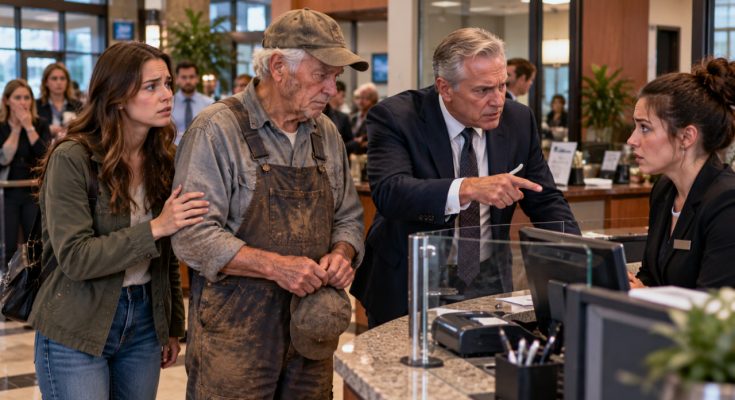
“All right,” he said. “That’s enough remembering for one morning. I’ve got a tractor waiting on me.”
Tom stood immediately.
“Of course.”
But before we left the basement, he made one more request.
“Earl, will you have lunch with me next week? I’d like to hear how the farm is doing. And I’d like to talk about something I’ve been thinking about for a long time.”
Grandpa raised an eyebrow.
“If this is about investing in some new bank scheme, you can save your breath.”
Tom laughed.
“No schemes. I promise.”
“Then we’ll see.”
We carried the box back to Tom’s office, where he locked it away again.
Then we returned to the lobby.
The teller was still at window three.
When she saw Grandpa, she stood up.
“Mr. Doyle?”
Grandpa stopped.
She came around the counter, her face flushed.
“I’m sorry,” she said. “I shouldn’t have spoken to you the way I did. I made assumptions about you, and I treated you disrespectfully. There was no excuse for that.”
Grandpa studied her for a moment.
“What’s your name, young lady?”
“Emily.”
“Emily, do you know how long I’ve been farming?”
She shook her head.
“No, sir.”
“Sixty-two years. You know what that teaches you?”
She waited.
“That a field doesn’t care what you look like. You can wear the finest clothes in the county, but if you don’t know how to work the soil, nothing will grow. And you can have mud on every inch of your boots and still be the best farmer in the valley.”
Emily lowered her eyes.
“I understand.”
“Do you?” Grandpa asked gently. “Because understanding something means you do better next time.”
She nodded.
“I will.”
Grandpa put his cap back on.
“Good. That’s all I ask.”
Then he turned toward the exit.
I followed him through the glass doors and out into the bright autumn sunshine.
The old Ford was parked beside the curb, its muddy tires leaving little marks on the pavement.
Grandpa climbed into the driver’s seat and put the key in the ignition.
I sat beside him.
For a moment, neither of us spoke.
Then I finally asked the question that had been bothering me since we entered the bank.
“Grandpa, why didn’t you ever tell me about all that?”
He started the engine.
“About what?”
“About helping save the bank. About Tom. About Grandma’s notebook.”
He looked out through the windshield.
“Because it wasn’t something I did to become important, son. It was something I did because people needed help.”
He shifted the truck into gear.
“And besides, your grandmother was the one who kept everything together. If anyone deserved to be remembered, it was her.”
We pulled away from the curb.
As the bank disappeared in the rearview mirror, I glanced at Grandpa’s muddy boots resting against the floor mat.
They looked exactly the same as they had that morning.
But I knew I would never look at them the same way again.
I thought our story ended there.
I thought we would pick up the tractor belt, return to the farm, and go back to our ordinary lives.
But the following Monday, when Grandpa and I drove into town again, there was a crowd gathered outside the bank.
And standing beside the front doors was Emily, the young teller.
She was holding a large envelope with Grandpa’s name written across the front.
When she saw our truck, she hurried toward us.
“Mr. Doyle,” she called. “Please. You need to see this.”
Grandpa switched off the engine.
“What is it now?”
Emily held out the envelope.
“Mr. Callahan asked me to give you this personally.”
Grandpa opened it.
Inside was a letter.
He read the first few lines.
Then he looked at me, and I saw that familiar expression cross his face—the one he wore when a storm was coming and he was trying to decide whether to bring the cattle in early.
“What does it say?” I asked.
Grandpa folded the letter carefully.
“It seems,” he replied, “that your grandmother left behind one more surprise.”
He looked toward the bank.
“And this time, son, I think the whole town is going to hear about it.”
Grandpa opened the envelope again, and this time, he read the letter aloud.
“Dear Earl,
For eleven years, I’ve kept a promise to a woman who believed that a person’s character was worth more than all the money in this building.
Your wife asked me to wait until the right moment to share her final request with you. After what happened last Tuesday, I believe that moment has arrived.
Please come inside. There are people here who need to hear her story.
—Tom Callahan.”
Grandpa sighed.
“Your grandmother always did enjoy making a simple morning complicated.”
But I saw him straighten his shirt before stepping out of the truck.
When we entered the bank, nearly thirty people were gathered in the lobby. Farmers, shopkeepers, retired teachers, and older residents stood beside the waiting chairs. Some carried old photographs. Others held envelopes and documents.
Tom stood near the counter.
When he spotted Grandpa, he walked over and shook his hand.
“Thank you for coming, Earl.”
Grandpa looked around.
“Tom, what’s all this?”
Tom turned toward the crowd.
“Eleven years ago, Martha Doyle asked me to preserve a piece of this town’s history. She believed that the people who built our community deserved to be remembered—not because they were wealthy, but because they helped others when there was no guarantee they would ever receive anything in return.”
He gestured toward a table near the windows.
On it sat the old wooden box, Grandma’s photograph, and a framed document.
Tom continued.
“Many of you remember the financial crisis this bank faced decades ago. Some of you helped keep it open. Others received loans when no other institution would take a chance on you. What many people don’t know is that Martha recorded those stories for years.”
He lifted the black notebook.
“She documented the farmers who helped their neighbors, the shop owners who extended credit to struggling families, and the people who quietly paid for school supplies when parents couldn’t afford them.”
An elderly man near the back raised his hand.
“Martha paid my daughter’s school fees one year,” he said. “She told me it was a scholarship. I found out only after she passed that she’d used her own money.”
A woman beside him nodded through tears.
“She brought meals to my mother every Thursday. Never told anyone. Never asked for anything.”
Grandpa lowered his head.
That was Grandma.
She had spent her life doing things that seemed small to her and enormous to everyone else.
Tom placed the framed document on an easel.
“After Martha passed away, I began speaking with our board about creating a permanent community program in her honor. We wanted to support local farmers, help young people pursue education, and provide emergency assistance to families facing difficult times.”

One Comment on “PART 4 – A Bank Teller Called Security on My 84-Year-Old Grandpa Over $2,000—Then He Asked for the Bank President by Name”