PART 4
He recommended that I review my full credit files with all three major bureaus and check my banking records for unfamiliar accounts or transactions.
I agreed.
Then I told him about the sale.
He knew I had been negotiating with a storage company, but he hadn’t known the deal had closed.
When I told him the final price, he removed his glasses.
“Congratulations,” he said.
“Thank you.”
“Does Pam know?”
“No.”
“Does Jordan?”
“No.”
Robert was quiet for a moment.
“Well, that makes the situation more delicate. Not because you owe anyone an explanation of every dollar you own, but because money has a way of changing people’s behavior. We should document your current assets, make sure your accounts are secure, and review your estate documents.”
I had already been thinking about that.
My will was old. It had been drafted years before I met Pam. I needed to update it to reflect my current circumstances, but I wanted to do that carefully and without making decisions out of anger.
Robert understood.
“Your estate plan should reflect your considered wishes,” he said. “Not punishments you invent in the middle of a family crisis.”
That sentence stayed with me.
I wasn’t interested in revenge.
I wanted to protect what I’d built, make sure my retirement was secure, and decide what kind of relationship I could have with people who had betrayed my trust.
Before I left, Robert asked me to send him the closing documents from the storage sale and the relevant bank records.
“I’ll review everything,” he said. “And Gary? Until we understand the full situation, don’t announce the sale.”
I agreed.
Then I drove to my office.
The little window unit was rattling as usual. The coffee pot was nearly empty. A tenant had left a message about a jammed gate, and somebody had forgotten to put a lock on Unit 214.
For an hour, I did the ordinary work.
I called the gate technician. I spoke to a tenant who wanted to extend her payment date. I swept the office floor.
I didn’t tell anyone I’d sold the business.
I didn’t tell anyone that I could buy the entire block of buildings and still have enough left to retire comfortably.
At noon, my phone rang.
It was Pam.
“Gary, where are you?”
“At the office.”
“Can you come home?”
“Is something wrong?”
She hesitated.
“Jordan called.”
I put down my pen.
“What did he say?”
“He says he wants to apologize.”
I leaned back in my chair.
“What exactly did he say?”
“He told me he knows he made a terrible mistake. He said he wants to sit down with us tonight and explain everything.”
“Did he say he would bring the account records?”
“No.”
“Did he say he would provide a list of every card he opened and every dollar he spent?”
“Did he say he would pay back the money he took from you?”
A pause.
“He said he would make things right.”
I looked through the office window at the gravel lot.
“Pam, those are different things.”
“I know.”
“Do you?”
Her voice broke.
“Gary, please. He’s my son.”
“I know he’s your son.”
“I don’t want to lose him.”
“Neither do I want to see you lose your retirement.”
She went quiet.
I felt sorry for her. I really did.
She was trapped between the man she’d married and the child she’d spent decades trying to protect. Even though Jordan was a grown man with children of his own, some part of her still seemed to believe that if she could just find the right words, she could bring him back to the person she remembered.
But love without boundaries can become a kind of surrender.
And Jordan had learned that his mother would surrender almost anything to keep him from facing consequences.
“I’ll come home this evening,” I told her. “But we are not making any promises until we know the facts.”
“Thank you.”
“And Pam?”
“Yes?”
“Don’t give him any more money.”
“I won’t.”
I hung up.
At 3:20, Robert’s office called to say they had received the first batch of records from my credit-card disputes. It was too early to draw conclusions about every transaction, but one detail stood out.
The cards had been linked to contact information associated with Jordan.
That was consistent with what we’d already seen.
The attorney’s office was preparing a more complete timeline, and they wanted me to keep every original document.
I agreed.
Then, at 4:05, I received a call from an unfamiliar number.
A woman introduced herself as a representative of one of the credit-card companies’ fraud departments.
She needed to verify several details.
Had I applied for a card ending in 1842?
No.
Had I authorized cash advances totaling several thousand dollars?
No.
Had I lived at the apartment address listed on the application?
No.
Had I given anyone permission to use my Social Security number to obtain that account?
“No,” I said. “I did not.”
She explained the next steps and gave me a case reference number.
I wrote it down.
After the call, I sat for a long time, staring at the page.
There was something humiliating about having to prove that you hadn’t done something you had never done.
But humiliation wasn’t a reason to stop.
I had built my business by keeping records, checking numbers, and refusing to accept explanations that didn’t make sense.
I would do the same here.
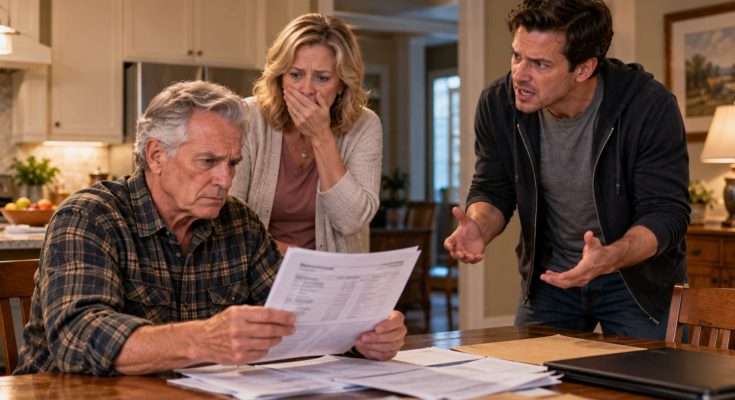
That evening, I arrived home at six.
Pam was waiting in the living room. She had changed clothes and put her hair up. There was a plate of food on the dining table, but neither of us was hungry.
Jordan arrived twenty minutes later.
He came alone.
He wore a clean shirt and had shaved. He looked like a man preparing for a job interview rather than someone who had spent the previous evening admitting to financial fraud.
“Gary,” he said, “I owe you an apology.”
I motioned toward the chair opposite me.
“Sit down.”
He sat.
“I know I crossed a line. I was desperate, and I made a stupid decision. I never intended for it to get this far.”
“How long have you been using my information?”
He looked at Pam.
“Gary asked you a question,” she said.
He exhaled.
“About three years.”
“Three years,” I repeated.
“Yes.”
“How many accounts?”
“Three.”
“Are you certain?”
He hesitated.
“I think so.”
“Think so?”
“I might have tried applying for another one, but I don’t think it went through.”
I wrote that down.
“Which bank?”
“I don’t remember.”
“Then you’ll need to find out.”
He rubbed his palms against his trousers.
“Gary, I know this looks terrible. But I really was going to fix it. I kept thinking I could win enough money to pay everything off. Every time I lost, I thought the next time would be different.”
“That is how gambling works when you’re chasing losses. The next bet feels like a solution, even when it is making the problem worse.”
He looked surprised that I understood.
“I didn’t know what else to do.”
“You could have stopped gambling. You could have told your mother you were in trouble. You could have found work and made a repayment plan. You could have spoken to a debt counselor.”
He lowered his eyes.
“Yes.”
“Instead, you used my identity and told your mother I was the gambler.”
He nodded.
“Yes.”
“Why?”
His answer came so quietly I almost didn’t hear it.
“Because if she thought it was me, she wouldn’t have helped.”
Pam made a small, wounded sound.
Jordan turned toward her.
“Mom, I didn’t want to hurt you.”
“But you did.”
“I know.”
“You made me believe Gary was lying to me.”
“I know.”
“You let me use my retirement to pay your debts.”
He covered his face.
“I know!”
The room fell silent.
For a moment, I felt something like sympathy. Not forgiveness, but recognition. I had made mistakes in my life. I had taken risks that frightened me. I’d had months when the business barely covered its bills. I understood what desperation could do to a person.
But desperation did not excuse every choice.
And remorse was only the beginning of taking responsibility.
I slid a blank sheet of paper toward him.
“Write down every account you opened using my information. Every card, every application, every mailing address, every email address, every phone number. Include any accounts you attempted to open, even if you believe they were rejected.”
He stared at the paper.
“All of them?”
“All of them.”
“Why?”
“Because we need the truth.”
He looked at Pam.
She nodded.
“Do what Gary is asking.”
Jordan picked up the pen.
He wrote the names of the three credit-card companies. He wrote the apartment address. He listed an email address and two phone numbers.
Then he stopped.
“There’s something else,” he said.
I felt my stomach tighten.
“What?”
He looked at his mother.
“I used your information on a loan application.”
Pam gripped the arm of her chair.
“What loan?”
“A personal loan.”
“How much?” I asked.
“Fifteen thousand.”
“Was it approved?”
“No.”
“Did you sign my name?”
He looked down.
“Yes.”
“Did you use my Social Security number?”
“Yes.”
“Did you submit it to a bank?”
“Yes.”
I wrote down the details he provided.
“Anything else?”
He shook his head.
I waited.
He stared at the paper.
“There’s something I haven’t told you about the money Mom paid.”
Pam leaned forward.
“Jordan, what now?”
He swallowed.
“Not all of it went to the cards.”
My hands went still.
“Where did it go?”
“Some of it went toward my rent. Some went toward the car. Some went toward the gambling debt.”
“How much went to the credit-card accounts?”
“I don’t know exactly.”
“Then you’ll find out.”
He rubbed his eyes.
“I can pay Mom back. I can get another job. I can sell the car.”
Pam began to cry again.
“I don’t want your car, Jordan. I want my son back.”
He looked at her, and for the first time that evening, his expression changed. He seemed to understand that she wasn’t asking for money.
She was asking him to become someone she could trust.
“Mom,” he whispered, “I’m sorry.”
She wiped her cheeks.
“I’m glad you’re sorry. But being sorry doesn’t mean I can keep paying for your choices.”
He nodded.
I watched him carefully.
It was the first sensible thing he had heard all evening, and I hoped he understood it.
We spent another hour discussing the records he needed to gather. I made it clear that I wasn’t agreeing to pay his debts or promising to keep the matter out of the hands of the authorities. I would let the appropriate professionals advise me on the next steps.
Jordan looked frightened when I said that.
“Gary, please. You can’t report me.”
“I haven’t decided what steps are necessary. But I won’t lie about what happened.”
“That could ruin my life.”
I held his gaze.
“You were willing to risk mine.”
He had no answer.
When he left, he took the list of records he needed to provide. Pam watched him walk down the driveway.
Then she turned to me.
“Are you going to tell me what was in the folder you brought last night?”
I looked at her.
“What do you mean?”
“The other papers. The ones you haven’t shown me.”
I knew exactly what she meant.
The sale documents were still in my briefcase, along with the closing statement and the letter from the buyer confirming that the transaction had been completed.
I could have told her then.
But I wanted to be certain I wasn’t using the news as a weapon. I didn’t want to throw a number on the table and watch the whole conversation change.
So I told her the truth, as far as I was ready to tell it.
“There’s something important about my finances that I haven’t shared with you. I was planning to tell you soon.”
Her face tightened.
“Is it bad?”
“No.”
“Are you in debt?”
“No.”
“Gary, please. I can’t handle another secret.”
I looked at her for a long moment.
“It’s not a secret that puts us in danger. But I want to deal with what happened first. Then I’ll tell you everything.”
She nodded slowly, though I could see she wasn’t satisfied.
That night, I slept in the guest room.
Not because I wanted to punish her.
Because I needed a little distance to think.
The next morning, I woke before sunrise and went for a walk along the road behind our house. The air was cool, and the fields were quiet. I could hear a dog barking somewhere in the distance.
I thought about my father.
He had taught me that a man’s word was worth more than his possessions. He wasn’t a rich man. He worked with his hands, fixed things himself, and believed that if you borrowed something, you returned it in better condition than you received it.
When I was seventeen, I once took twenty dollars from his dresser without asking. I intended to replace it after a friend paid me back for something I’d bought him.
My father discovered the missing money before I could replace it.
He didn’t shout. He didn’t hit me.
He sat me down at the kitchen table and asked me one question.
“Son, if I can’t trust you with twenty dollars, why should I trust you with anything bigger?”
I never forgot it.
I returned the money and apologized. It took time for him to trust me again, but I learned that trust wasn’t something you could demand simply because you were family.
You earned it through what you did when nobody was watching.
Jordan had spent three years doing the opposite.
And Pam had spent three years helping him hide it.
When I returned home, she was sitting at the kitchen table with two cups of coffee.
“I made yours the way you like it,” she said.
I sat down.
For a few minutes, we talked about ordinary things. The weather. The fence that needed repairing. A letter from her sister.
Then she set down her cup.
“I want to understand something,” she said.
“All right.”
“Why didn’t you ever tell me how much the storage business was worth?”
I looked at her.
“What makes you think it’s worth anything unusual?”
She shook her head.
“You’re not as difficult to read as you think, Gary. You’ve been different for a week. You’ve been taking calls outside. You brought home papers from your lawyer. And yesterday, when Jordan said you couldn’t afford legal help, you didn’t even blink.”
I almost smiled.
“You’re paying attention now.”
“Yes. I am.”
She took a breath.
“Have you sold the business?”
I didn’t answer immediately.
Then I nodded.
“Yes.”
Her eyes widened.
“When?”
“Last week.”
She stared at me.
“How much?”
I looked down at my coffee.
“Nineteen million eight hundred thousand dollars.”
For several seconds, she didn’t move.
The kitchen seemed to go silent around us.
Then she whispered, “What?”
“I sold all three storage lots. The transaction closed last week.”
She pressed her hand against her chest.
“Gary, that’s… that’s almost twenty million dollars.”
“Yes.”
“You own almost twenty million dollars?”
“Not exactly. That’s the sale price, before the final tax calculations, expenses, and other adjustments. But yes, the sale has made me considerably wealthier than I was before.”
She stared at me as though she were seeing a stranger.
“Why didn’t you tell me?”
I could have said I wanted to surprise her. That I was waiting for our anniversary. That I’d spent thirty years building the business and wanted one quiet week to myself before explaining what came next.
All of those things were true.
But they weren’t the whole truth.
“I wanted to know whether I was loved for who I was, not for what I owned.”
She looked wounded.
“Did you think I only loved you for your money?”
“No. I thought I knew you well enough to believe you didn’t. But I also wanted to understand what happened when the people around me thought I had nothing.”
She shook her head.
“You tested me.”
“I suppose I did.”
“That isn’t fair, Gary.”
“No,” I said quietly. “It isn’t entirely fair.”
I didn’t pretend otherwise.
“I should have spoken to you before the sale. I should have told you that I was considering it and explained what I planned to do. I wanted to surprise you, and I allowed that plan to become a reason to keep you in the dark.”
She wiped her eyes.
“But you didn’t have to tell me every detail of the business before you were ready.”
“No. But I should have trusted you enough to tell you about something this important.”
We sat quietly.
Then she asked the question I had been expecting.
“Does Jordan know?”
“No.”
“Are you going to tell him?”
“Not now.”
She looked toward the window.
“He’ll find out eventually.”
“Probably.”
“What will happen when he does?”
I took a slow breath.
“I don’t know.”
For the first time since the sale, I felt the full weight of the money.
It wasn’t just a number anymore. It was a test I hadn’t asked for, one that would reveal things about the people around me and perhaps about myself.
I could pay off every debt Jordan had accumulated.
I could replace every dollar Pam had withdrawn from her retirement.
I could buy a new house, a new truck, and anything else I wanted.
But I couldn’t buy back the three years Pam had spent worrying about a lie.
I couldn’t erase the signatures on those applications.
And I couldn’t make Jordan become an honest man by transferring money into his account.
“I want to do something for us,” I told Pam. “But first, we have to decide what our marriage is going to look like after this.”
She nodded.
“I understand.”
“I also want you to speak with your own financial adviser, someone independent who can help you understand what happened to your retirement and what choices you have now.”
“All right.”
“And Jordan’s debts need to be handled separately. We aren’t going to use the sale proceeds to make his problems disappear.”
She swallowed.
“All right.”
I believed she meant it.
But I also knew promises made in a quiet kitchen could be tested the moment a frightened son called his mother.
That afternoon, Jordan called.
Pam answered while I was sitting on the back porch.
I couldn’t hear his words, but I could hear her responses.
“No.”
A pause.
“Because we need to know the truth.”
Another pause.
“No, Jordan. I am not sending you money.”
Then she said something that made me look up.
“Gary sold the storage business.”
I stood.
Pam had turned away from the window, but I could hear her voice clearly now.
“Yes. He sold it last week.”
Silence.
Then Jordan’s voice rose so loudly that I could hear it through the phone.
“How much?”
Pam closed her eyes.
“That’s not the point.”
“How much, Mom?”
She looked at me through the glass.
I shook my head slightly.
She turned away.
“It’s a private matter, Jordan.”
He said something else.
Then Pam answered, “No. He is not going to pay your debts.”
The call ended abruptly.
Pam lowered the phone.
For a moment, neither of us moved.
Then she walked outside and sat beside me.
“He knows,” she said.
“I gathered that.”
“He wants to come over tonight.”
“Why?”
“He says he needs to talk to you.”
I watched a hawk circle above the field.
“Did he say anything else?”
She hesitated.
“He said he has an idea.”
I turned toward her.
“What kind of idea?”
“He says he can fix everything. He wants to explain it in person.”
I felt a familiar heaviness settle in my chest.
“Pam, I want you to understand something. We are not going to make financial decisions because Jordan has discovered I have money.”
“I know.”
“If he has a legitimate plan to repay what he owes, we’ll listen. If he wants help getting treatment for his gambling, we can discuss that too. But we are not handing him a check because he suddenly believes I can afford it.”



One Comment on “PART 4 – My Stepson Made My Wife Pay $700 a Month for My “Gambling Debts”—Then I Checked My Credit Report”