PART 4
My husband was sitting at the kitchen table when I walked in.
There were two cups of coffee on the table, one beside his hand and one on the empty chair across from him.
He had never made me coffee when I came home from work before.
Not once in all those years.
“Sit down,” he said.
I hung up my coat.
“I’m tired.”
“We need to talk.”
I looked at the coffee.
It was already cold.
“Then talk.”
He rubbed his face.
“I know what you saw today.”
“All right.”
“And I know how it looked.”
I waited.
He seemed irritated by my silence.
“Go ahead.”
He took a breath.
“Things between us haven’t been good for a long time.”
I looked at him.
“We were married this morning.”
“You know what I mean.”
“I do. I just want to hear you say it.”
He pushed his chair back slightly.
“I’ve been unhappy.”
The words landed softly, almost politely.
As though he were telling me that the restaurant had run out of his favorite pie.
I sat down across from him.
“How long?”
He looked away.
“A while.”
“How long?”
“Since last year, maybe.”
I thought about last Christmas, when I had bought him the leather wallet he had pointed out in a store window. I thought about his birthday dinner, the cake I had made from scratch, and the weekend I spent caring for him after he had the flu.
I thought about January, when he had signed the lease with another woman.
“And you thought the best way to handle that was to rent an apartment with someone else while I kept washing your shirts?”
His face flushed.
“That’s not fair.”
“No?”
“You don’t understand what I’ve been going through.”
I almost asked him what he had been going through.
I almost asked whether he had spent sleepless nights wondering how to pay the electric bill, whether he had ever counted the remaining dollars in a grocery envelope before deciding what to put back on the shelf, whether he had ever worked through a fever because missing a day meant missing money we needed.
But I already knew what his answer would be.
He would make his suffering the center of the conversation.
He would turn my questions into accusations and my pain into evidence that I was unreasonable.
So I asked something else.
“Why did you tell me the house was in danger?”
He went quiet.
“I told you the bank was looking at our finances.”
“You told me we could lose the house unless I signed those papers.”
“I was trying to protect our assets.”
“From whom?”
He rubbed the back of his neck.
“Which creditors?”
He didn’t answer.
I leaned back in my chair.
“That’s what I thought.”
His expression changed.
“You’ve been talking to somebody.”
It wasn’t a question.
I said nothing.
“Your sister,” he muttered. “She’s always hated me.”
“Dee has never hated you.”
“She’s always thought she knew better.”
“She called a lawyer because I found a lease with your name on it.”
He stared at me.
For the first time that evening, he looked genuinely frightened.
“How much did you tell her?”
“Enough.”
He stood so abruptly that his chair scraped across the floor.
“You had no right to go behind my back.”
I looked up at him.
“You signed a lease with another woman while you were married to me.”
“That’s different.”
“How?”
He opened his mouth.
Then he closed it.
I waited.
Finally, he said, “I made a mistake.”
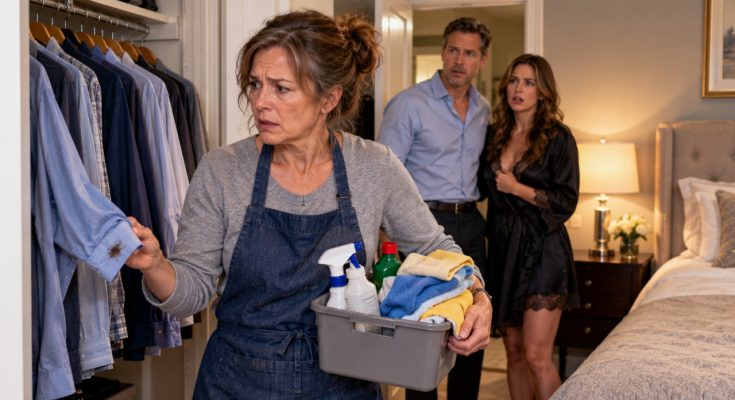
I thought about the shirts in her closet.
The razor under her sink.
The lease.
The moving company receipt.
The money he had been promising her.
Those weren’t mistakes.
They were decisions made over months, each one requiring another lie to keep the previous lie alive.
“You made a lot of decisions,” I said. “A mistake is what happens when you forget to buy milk.”
He stared at me as if he had never heard me speak that way.
Maybe he hadn’t.
For most of our marriage, I had swallowed my anger before it could become a sentence.
I had believed keeping the peace was part of keeping a family together.
Now I wondered how much peace I had actually been protecting.
He sat down again.
“Listen,” he said, lowering his voice. “We can work this out privately. There’s no need to involve lawyers.”
I thought about the lawyer’s office in Evansville.
The papers on her desk.
The way she had taken off her glasses and looked directly at me.
Nobody says a word to your husband.
I hadn’t understood the importance of that instruction until now.
“Why don’t you want lawyers involved?” I asked.
“Because lawyers make everything expensive.”
“Then tell me the truth, and we won’t have to guess what the papers mean.”
He looked at the table.
For a long moment, neither of us spoke.
Then he said, “I may have some debts.”
“What kind of debts?”
“Business debts.”
“What business?”
He sighed.
“I invested in a few things.”
I had never known him to run a business. He had worked for the same regional supply company for years, and he had always described himself as an employee.
“What things?”
“Just investments.”
“How much money?”
“I don’t know exactly.”
I stared at him.
“You don’t know how much money you owe?”
“I said I don’t know exactly.”
“Is that why you wanted the house in my name?”
He looked up sharply.
“No.”
“Then why?”
“To protect you.”
I could almost hear the lawyer’s voice in my head.
Do not tell him. Not one word.
I kept my face still.
“Protect me from what?”
He looked away again.
“I don’t want you worrying about things you don’t understand.”
That was when I knew he wasn’t going to tell me the truth.
Not because he was incapable of it.
Because the truth would cost him something.
I stood.
“I’m going to bed.”
He reached for my wrist.
“Please. Don’t do this.”
I gently pulled away.
“Do what?”
“Treat me like I’m some kind of criminal.”
I looked at him for a long time.
“I don’t know what you are anymore.”
Then I walked upstairs.
I slept in the guest room that night, with the door locked and my phone on the bedside table.
At 1:13 a.m., I heard him walking around downstairs.
At 1:26, the back door opened.
At 1:41, it closed again.
I didn’t move.
The next morning, he left for work before I came downstairs.
Beside the coffee maker was a folded piece of paper.
For a moment, I thought it might be an apology.
It wasn’t.
It said:
We need to make a plan. Don’t do anything that could hurt both of us.
I read it twice.
Then I placed it inside the folder where I had begun keeping every document related to the house.
Not because the note proved anything on its own.
But because I was finally learning that words mattered less than patterns.
And my husband had developed a pattern I could no longer ignore.
The Papers He Never Expected Me to Read
By Thursday morning, I had made a decision.
I would keep going to work.
I would keep cleaning my four regular houses.
I would keep my appointments, pay my bills, and make dinner for myself.
And I would stop trying to solve my husband’s problems before I understood what those problems actually were.
It sounds simple when written down.
In real life, it was harder.
For twenty-eight years, I had treated his moods like weather. If he came home angry, I searched for what might have gone wrong at work. If he worried about money, I checked our accounts and tried to find ways to save. If he became distant, I wondered what I had failed to do.
I had spent so much time adjusting myself to his behavior that I barely noticed how little he adjusted himself to mine.
On Thursday, I went to the lawyer’s office again.
She was a woman in her fifties named Margaret Ellis, with silver-framed glasses, a neat gray bob, and a way of asking questions that made it difficult to hide behind vague answers.
I handed her the note.
She read it without changing her expression.
“Did he say anything else?”
I told her about our conversation at the kitchen table, including the debts and the investments.
She wrote something on a yellow pad.
“Do you have access to your financial records?”
“Some of them.”
“Do you have separate bank accounts?”
“We have a joint checking account. I have my own account where I deposit money from cleaning jobs.”
“Good. Don’t move money out of the joint account without getting advice about your obligations and the law. Don’t sign anything new. And don’t destroy or alter any records.”
I nodded.
She opened the folder containing the refinance documents.
“Did you receive a copy of everything you signed?”
“Yes.”
“Bring it to me. Every page. Including the attachments.”
“I have them at home.”
“Good. I also want the deed, your mortgage statements, tax returns if you have access to them, and any correspondence concerning these supposed creditors.”
I hesitated.
“What if he finds out I’m doing this?”
Margaret put her pen down.
“He may find out eventually. But you are allowed to understand your own financial position. You don’t need his permission to ask questions about documents you signed.”
I looked at the papers on her desk.
“I thought putting the house in my name would protect me.”
“It may have changed your legal position, but we need to understand exactly what was transferred, what debts exist, and whether the transaction was properly disclosed. Sole title does not automatically erase a mortgage or make every creditor claim disappear.”
Her words frightened me more than I expected.
“So I could still lose it?”
“I won’t promise you that you can’t. I also won’t assume you will. That’s why we review the documents before making conclusions.”
For the first time since Tuesday, I felt as if somebody were speaking to me without trying to control what I believed.
Margaret continued.
“One more thing. Do you have reason to believe your husband has access to your personal email or financial accounts?”
I thought about the shared computer in the study, the passwords we had used for years, and the way he occasionally asked me to read verification codes aloud.
“I’m not sure.”
“Then use a device he doesn’t control to contact your bank and review your security settings. Change your personal passwords. Ask the bank about account access and alerts. Don’t assume that changing the deed means your finances are separate.”
I wrote everything down.
It was the first list I had made in years that wasn’t about groceries, cleaning supplies, or somebody else’s needs.
When I left the office, the sky over Evansville was gray, and rain was beginning to collect along the edges of the parking lot.
I sat in my car and looked at the grocery sack beside me.
Inside it was my cleaning ledger.
Eleven years of handwritten appointments, payments, supplies, and mileage.
I had taken it because Dee insisted it mattered.
Now I understood that the ledger represented something I had never given myself credit for.
I had built a life.
It might not have been glamorous. It might not have come with a pension or an office or a title that impressed anyone at a dinner party.
But I had worked.
I had earned money.
I had paid bills.
I had shown up, week after week, even when I was tired or worried or sick.
My husband had spent years making me feel financially dependent on him, yet I had records of my own labor stretching back more than a decade.
I was not helpless.
I was frightened.
Those were two very different things.
That afternoon, I began collecting documents.
I found the deed in a filing cabinet beneath old insurance policies. I found the refinance packet in a drawer in the study. I printed the mortgage statements available through our account and gathered the tax records I could legally access.
I did not break into his email.
I did not take his personal papers that had nothing to do with me.
I collected records connected to my own property, my own signature, and our shared finances.
At the bottom of the refinance packet, I found a document I had not paid attention to in March.
It was an acknowledgment of financial disclosures.
My signature appeared on the last page.
Above it was a paragraph stating that I had received and reviewed certain information concerning the transaction.
I stared at it.
I remembered signing the papers at the kitchen table. I remembered the notary arriving with a briefcase. I remembered my husband placing little yellow tabs beside each signature line.
I did not remember receiving the financial information described in the acknowledgment.
I called Margaret’s office.
Her assistant told me to bring the packet in the next morning.
I did not sleep well that night.
My husband was home by seven, carrying a paper bag from the restaurant where he sometimes stopped for dinner.
He placed it on the counter.
“I got you something.”
Inside was a slice of pecan pie.
My favorite.
I looked at it for a long moment.
He used to bring me small treats when he traveled for work. A candy bar from a gas station. A pastry from a bakery. Once, years ago, he brought me a tiny bottle of perfume because he said it smelled like the flowers outside our first apartment.
I had kept that bottle long after the scent faded.
Now the pie felt like a prop in a play I hadn’t agreed to attend.
“Thank you,” I said.
He watched me.
“Are you still angry?”
“I’m thinking.”
“About what?”
“Everything.”
He pulled out a chair.
“Look, I know I haven’t handled this well.”


One Comment on “PART 4 – I Cleaned My Husband’s Mistress’s House Every Tuesday for a Year—Then I Found His Shirts in Her Closet”