PART 3
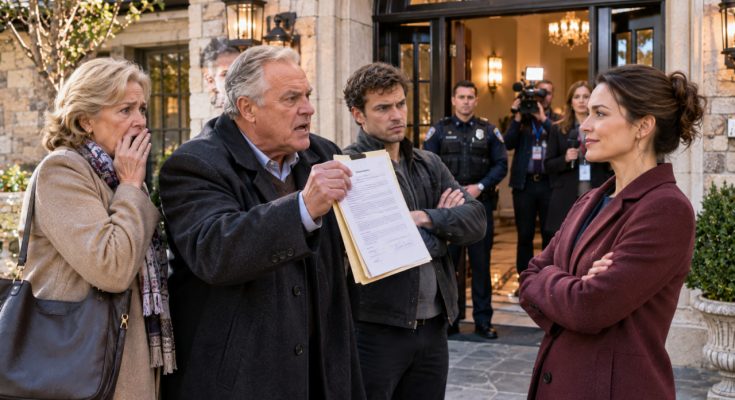
Marcus stepped forward, holding a thick black binder.
“Mr. Voss, I suggest you stop speaking before you make your situation considerably worse.”
Dad stared at him.
“Who are you?”
“Marcus Hale. I represent the legal owner of this property.”
Dad pointed at me.
“She’s my daughter. We have a legal agreement.”
Marcus opened the binder.
“Then perhaps you can explain why the signature on this agreement does not match the owner’s verified signature, why the notary identification number belongs to a deceased notary, and why the supposed psychiatric assessment was never authorized by the physician whose name appears on it.”
The locksmith slowly stepped away from Nathan.
“I told you something wasn’t right,” he muttered.
Nathan immediately turned toward him.
“You agreed to do this!”
“I agreed to open a property after being shown legal authorization. I did not agree to participate in a fraud.”
Dad’s face turned red.
“This is ridiculous. We have a lease. We have every right to be here.”
Marcus pulled another document from the binder.
“No, you don’t.”
He handed a copy to the officer.
“This is the recorded deed. The property is owned by Voss Creative Holdings, an entity established independently of Mr. Voss’s company. Elena Voss is its sole beneficial owner.”
Dad snatched the paper.
He examined it.
Then he examined it again.
I watched the realization slowly settle into his face.
He had spent months believing he could take my house because he assumed I had purchased it carelessly.
He had never imagined I had structured the ownership through my own company.
“You hid this from us,” he whispered.
I stepped closer.
“Why would I tell you?”
“Because we’re family!”
I almost laughed.
Family.
That word had been absent from thirty-one Christmases.
But suddenly, standing outside a house worth millions of dollars, he remembered how to pronounce it.
“You forgot my birthday last month,” I said quietly.
Mom immediately interrupted.
“Elena, please. This isn’t the time.”
“You forgot my birthday. Again. But you somehow remembered the address of my house.”
Her eyes filled with tears.
“We’ve been worried about you.”
“No, Mom. You’ve been worried about Dad’s company.”
Nathan shifted his weight.
“Can we stop making this dramatic? We just need somewhere to stay temporarily.”
I looked at the two suitcases beside him.
“Temporarily?”
He shrugged.
“Things have been difficult.”
“Then you should have rented an apartment.”
Dad stepped between us.
“Your brother is in a difficult financial position. We came here to help him get settled. You’re making this unnecessarily complicated.”
I looked directly at him.
“Did you know about the $1.8 million loan guarantee?”
His mouth closed.
That was the first answer.
I continued.
“Did you know my name was used without permission?”
“That’s a business matter.”
“Did you know someone forged a psychiatric evaluation claiming I couldn’t make my own decisions?”
Mom started crying.
“Elena, we never wanted things to go this far.”
I turned toward her.
“Then why did you sign it?”
She stopped crying.
The silence was immediate.
Nathan looked at her.
Dad looked at her.
Even the officers exchanged a glance.
Marcus removed another page from the binder.
“Mrs. Voss, your signature appears on the submission cover sheet accompanying the fraudulent medical document. We also have the email account used to transmit it.”
Mom shook her head.
“I didn’t know what it was.”
Marcus remained calm.
“Then you should have no difficulty explaining that to investigators.”
My father suddenly turned toward the officers.
“This is a private family matter. I want these people removed.”
The older officer didn’t move.
“Sir, your daughter has provided evidence of suspected document fraud and unauthorized financial activity. We are investigating the circumstances surrounding your attempted entry.”
Dad pointed at me.
“She is lying!”
I had expected that sentence.
I had heard it in different forms since childhood.
But this time, nobody laughed.
Nobody nodded.
Nobody asked me to apologize for making him angry.
Instead, one of the reporters stood up from the dining room.
A woman with short gray hair and a notebook approached.
“Mr. Voss, my name is Rebecca Sloan. I’m an investigative journalist with the Arizona Ledger.”
Dad looked at her as if she had suddenly appeared from another planet.
“What are you doing here?”
Rebecca glanced at the damaged door.
“We’ve been investigating financial irregularities connected to Voss Development Group for several months.”
His face changed.
Marcus looked at me.
This was the part I had been waiting for.
Because my family had made one enormous mistake.
They believed the forged documents were an isolated incident.
They weren’t.
And the investigation had uncovered something much bigger.
Three months earlier, after discovering the fraudulent loan guarantee, Marcus had contacted the lender’s internal fraud department.
At first, the investigation seemed straightforward.
My father had submitted a guarantee in my name without my knowledge.
But the lender discovered several additional documents.
A second guarantee.
A third.
An authorization supposedly signed by me.
And an ownership statement claiming that I had invested $600,000 into Voss Development Group.
I had never invested a single dollar.
In fact, the company had received money from me only once.
The $12,000 I had sent my mother for employee health insurance.
The records showed that money had been transferred into a company account, then moved through several accounts controlled by Nathan.
When investigators examined the transactions, they discovered payments for luxury vacations, gambling-related transfers, expensive watches, and personal purchases.
My father had been reporting those expenses as business development costs.
Nathan had been enjoying the benefits.
And I had apparently been listed as one of the company’s silent investors.
My name was on financial documents I had never seen.
My signature was on guarantees I had never signed.
And my supposed investment had been used to make the company appear more financially stable than it actually was.
But the most disturbing discovery came from an email exchange between my father and the company’s financial consultant.
Dad had written:
If Elena objects, we can demonstrate that she has a history of emotional instability. Her mother can support the statement. Once the property is secured, the bank will have sufficient collateral.
The consultant had replied:
The medical documentation must be legitimate. Otherwise, it creates additional exposure.
Dad’s response was only six words.
We have someone who can handle it.
That email changed everything.
It wasn’t simply a father trying to borrow money.
It was a coordinated attempt to use my identity, reputation, and property to protect a failing business.
And the people standing outside my house had brought the evidence directly to my doorstep.
Back in the entrance hall, Rebecca approached my father.
“Mr. Voss, did you submit financial guarantees using your daughter’s identity?”
“No comment.”
“Did you instruct anyone to prepare a medical assessment claiming she was incapable of managing her affairs?”
“No comment.”
“Did your company receive $1.8 million in financing based partly on documents bearing her signature?”
Dad looked toward the officers.
“I want my attorney.”
Marcus nodded.
“That’s an excellent decision.”
Then Rebecca turned toward me.
“Elena, may I ask you one question?”
I nodded.
“Why did you agree to let us witness this?”
I looked at the damaged wooden door.
Then I looked at my mother.
“Because for thirty-one years, my family has told everyone a version of my life that made them look innocent and made me look difficult.”
I paused.
“I wanted the truth documented before they had another opportunity to rewrite it.”
Rebecca slowly lowered her notebook.
For the first time that morning, my mother looked genuinely frightened.
Not because the police were there.
Not because the reporters were recording.
But because the story she had spent decades telling was finally being challenged by people who weren’t afraid of my father.
The officers separated everyone.
The locksmith cooperated and provided copies of the communications Nathan had sent him.
He explained that Nathan had contacted him two weeks earlier, claiming to be a tenant who had lost access to a property after a dispute with the owner.
The forged lease had been emailed to him.
The locksmith had initially believed it was legitimate.
But when he arrived and saw the security cameras, the expensive property, and my explicit refusal to grant entry, he became uncomfortable.
That was why he had called Marcus after receiving a suspicious message from Nathan.
Nathan, however, had a different explanation.
He insisted Dad had arranged everything.
Dad insisted Nathan had handled the lease.
Mom claimed she had only signed what Dad gave her.
Within an hour, the three people who had arrived together were blaming one another.
I watched from the staircase.
It was almost surreal.
For years, they had presented themselves as an unbreakable unit.
They had agreed on every version of my supposed failures.
They had supported every accusation.
They had repeated every lie until even I occasionally questioned my own memory.
Now, when their actions had consequences, nobody wanted to stand beside anyone.
My father finally looked up at me.
“Elena, we need to talk privately.”
I didn’t move.
“About what?”
“About our family.”
I looked at him.
“You had thirty-one years to talk to me about our family.”
He lowered his voice.
“Don’t do this in front of strangers.”
I glanced at Rebecca.
“Why? Are you afraid they’ll remember what you say?”
He clenched his jaw.
“You’re making a terrible mistake.”
“No, Dad. The terrible mistake was believing that I would spend the rest of my life protecting you from the consequences of your decisions.”
His eyes narrowed.
“You think these people care about you?”
I didn’t answer.
He continued.
“They want a story. They don’t care if they destroy your family.”
I looked at the reporters.
Then back at him.
“You destroyed the family long before they arrived.”
By late afternoon, the initial police investigation had concluded.
My father and Nathan were not allowed to enter the manor.
The locksmith’s tools were returned to his van, and he provided a written statement.
The officers collected copies of the documents and photographs of the damaged door.
My attorney arranged for the evidence to be preserved and forwarded to the appropriate financial investigators.
My mother remained in the driveway for almost twenty minutes after everyone else had moved away.
She kept looking toward the entrance.
Eventually, she approached me.
“Can I come inside?”
I stood behind the doorway.
“No.”
Her eyes filled.
“I’m your mother.”
“I know.”
“Then how can you do this?”
I took a breath.
“Mom, do you remember the Christmas when I was eleven?”
She looked confused.
“The scarf you wrapped for me because you hadn’t bought me a present?”
Her expression changed.
“I remember.”
“You told everyone I refused to open my gifts because I was being difficult.”
“I was under a lot of pressure.”
“I was eleven.”
She looked down.
“I know.”
I continued.
“Do you remember when you and Dad went skiing without telling me when you were leaving?”
She started crying.
“Elena, please.”
“I remember waking up alone. I remember feeding the cat. I remember watching your Christmas video and hearing Dad tell everyone I had chosen not to come.”
She wiped her cheeks.
“We made mistakes.”
I nodded.
“Yes. You did.”
Then I asked the question I had carried for years.
“Did you ever love me the way you loved Nathan?”
She opened her mouth.
No words came.
And strangely, that silence hurt more than any answer she could have given.
After a long moment, she whispered:
“You were always so independent.”
I almost smiled.
There it was.
The explanation.
The family-approved version.
I was independent, so they forgot me.
I was strong, so they abandoned me.
I was capable, so they took from me.
I was the daughter who could survive anything, which apparently meant I deserved to be put through everything.
“Being independent doesn’t mean I didn’t need a mother,” I said.
She looked at me.
For a moment, I thought she might finally understand.
Then she asked:
“Could you at least help your father save the company?”
I stepped back.
And I closed the door.
Not violently.
Not angrily.
Just firmly.
That evening, Marcus and I sat in the library.
The fire burned quietly.
The reporters had left, promising to contact us before publishing anything that identified private financial information.
My attorney placed the black binder on the table.
“There is one more thing you need to see.”
I looked at him.
“What?”
He opened a section I hadn’t examined before.
Inside were copies of emails, bank statements, and a document from my father’s company’s accounting department.
“What am I looking at?”
Marcus turned the document toward me.
“Your father has been using your identity for longer than we initially believed.”
I stared at the first page.
It contained a list of financial transactions.
Dates.
Amounts.
Account numbers.
And my name.
Then I noticed the total.
$286,400.
My stomach tightened.
“What is this?”
“Payments and credit obligations associated with accounts your father represented as being connected to you.”
I slowly turned the page.
There were several accounts I had never opened.
One had been used to pay the mortgage on my parents’ home.
Another had been used to cover Nathan’s business expenses.