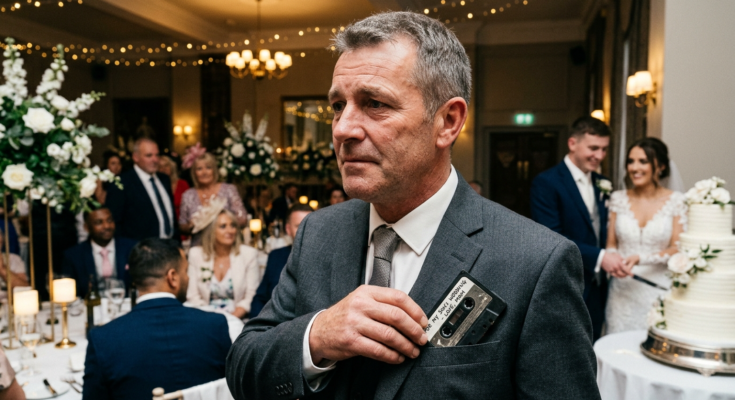
PART 7
Then the recording changed.
My wife’s voice became playful again.
“And now, my boy…”
My son wiped his face.
“You are going to dance with your wife.”
He laughed through his tears.
“Yes, you heard me.”
A few guests laughed too.
“You’re going to dance with her, and you’re going to stop looking at your father like he’s about to arrest you.”
That got a bigger laugh.
The DJ looked at me.
I nodded.
Then my wife’s voice said:
“There’s one more thing.”
The music stopped in the background.
A few seconds of silence.
Then:
“Son, if you ever find out why your father has this tape…”
My stomach dropped.
“What?”
My wife’s voice continued.
“…ask him about the envelope.”
My heart stopped.
I stared at the cassette deck.
The envelope.
I had forgotten.
No.
That wasn’t possible.
I’d never forgotten.
I’d buried it.
Eleven years ago, after she died, there had been an envelope in the toolbox beneath the cassette.
White paper.
My name written across it.
I had opened it.
Inside was one sheet of paper.
Three sentences.
And one instruction.
I had read it once.
Then I had folded it back up.
I had never told anyone.
Not my son.
Not my second wife.
Nobody.
The tape continued.
“The envelope is not for tonight.”
My second wife slowly turned toward me.
I felt her eyes on my face.
“It is for the day he asks you why I left something for the woman he would marry.”
The bride looked confused.
My son looked at me.
I couldn’t breathe.
My wife’s voice said:
“And if he asks…”
The tape clicked.
“…you tell him everything.”
The deck whirred.
Then silence.
The recording was over.
For several seconds, nobody knew what to do.
Then my son walked toward me.
Not fast.
Not angry.
Just slowly.
He stopped three feet away.
“What envelope?”
I looked at him.
His eyes were red.
“Dad.”
I didn’t answer.
“What envelope?”
My second wife spoke first.
“You have an envelope?”
I looked at her.
For the first time that evening, she looked afraid.
Not angry.
Afraid.
My son noticed.
His eyes moved between us.
“What’s going on?”
I reached into my jacket.
My fingers touched the old folded paper I’d carried for eleven years.
I had brought it with me that morning without knowing why.
Maybe I had known.
Maybe some part of me had understood that tonight was never just about a wedding.
I pulled it out.
The paper was yellowed around the edges.
My son’s name wasn’t on the front.
Neither was mine.
It simply said:
FOR THE DAY HE ASKS.
He stared at it.
“That’s Mom’s handwriting.”
“Yes.”
“Why didn’t you tell me about this?”
I looked at my second wife.
She wouldn’t meet my eyes.
That was when I understood something.
She knew.
Maybe not everything.
But she knew enough.
I turned back to my son.
“Because your mother asked me not to.”
His expression hardened.
“You said she didn’t leave anything.”
“I said she didn’t leave anything for you.”
“That isn’t the same thing.”
“No.”
He took the envelope.
His hands shook.
He opened it.
Inside was the same sheet of paper I’d read eleven years ago.
He unfolded it.
His eyes moved across the page.
Then stopped.
He read the first sentence aloud.
“Daniel…”
My wife’s voice wasn’t coming from the speakers anymore.
But somehow I could hear it anyway.
My son continued.
“If you are reading this, then your father has finally kept his promise.”
He looked up.
“What promise?”
I didn’t answer.
He read on.
“I need you to know something about the years before I got sick.”
His brow furrowed.
“What years?”
He looked at me.
“Dad?”
I felt the room changing.
The wedding was still there.
The flowers.
The cake.
The tables.
The champagne.
But suddenly none of it mattered.
Because there were things about our family that my wife had carried to her grave.
And apparently she hadn’t intended to keep them there.
My wife’s voice filled the ballroom.
“I don’t know your name yet. I don’t know what you look like. I don’t know whether you like apple pie or chocolate cake, whether you sleep on the left side of the bed or steal the blankets, whether you sing in the shower or hate doing dishes.”
A few people laughed through their tears.
“But I know my son.”
My boy lowered his head.
And I knew exactly what was coming.
Because there were things my wife knew about him that no one else in that ballroom had ever been told.
Things a mother knew because she’d been there before he could speak.
“He is going to make you angry sometimes,” she said. “He will probably leave his shoes somewhere they don’t belong. He will say he’s not hungry and then eat half your dinner. When he’s worried, he’ll get quiet. When he’s scared, he’ll pretend he’s annoyed. And when he thinks he’s disappointed you, he will pull away instead of asking you to forgive him.”
My son gave a tiny, broken laugh.
His bride looked at him.
He reached for her hand.
She took it.
My wife’s voice softened.
“Don’t let him do that.”
The ballroom seemed to lean toward the speakers.
“If you love him, don’t let him hide from you.”
I looked down at the floor.
That sentence wasn’t for the bride.
Not entirely.
My wife had spent years trying to teach our son that love wasn’t something you ran from when it became difficult.
And she’d spent years trying to teach me the same thing.
She had been better at it than I was.
The tape hissed again.
Then she said, “And there’s something else I want you to know.”
My stomach tightened.
I knew there was more.
That was why I’d carried that cassette for eleven years.
Not because I wanted to embarrass my son.
Not because I wanted to make some grand gesture at his wedding.
Because my wife had told me there was something on that tape I would need to hear when the right woman finally stood beside our boy.
And now that woman was standing twenty feet away.
“I want you to know that you did not take my place.”
My second wife’s glass slipped from her fingers.
It hit the floor.
The sound made several people turn.
But the tape continued.
“You could never take my place. Nobody can.”
My second wife stared at the speakers.
Her face had gone pale.
I didn’t look at her.
I couldn’t.
My wife’s voice went on.
“You are his mother now in whatever way he allows you to be. But I am still his mother too. I will always be his mother. And if somebody tells you that loving him means erasing the woman who came before you, don’t believe them.”
My son looked at his stepmother.
Then at me.
Then at his bride.
Nobody moved.
My second wife slowly bent down and picked up the broken glass.
She didn’t say anything.
The tape clicked softly.
And then my wife said something I hadn’t expected.
“My husband is going to tell you he did the best he could.”
I closed my eyes.
A few people laughed nervously.
My wife continued.
“He did.”
I opened my eyes.
“But sometimes his best was still terrible.”
The room erupted into startled laughter.
Even my son laughed.
I shook my head.
“That woman,” I muttered.
The DJ grinned.
My wife laughed again on the recording.
“I know he’s probably standing somewhere nearby looking embarrassed right now. Good. He deserves it.”
The bride smiled through her tears.
Then my wife’s voice changed.
It became quieter.
Serious.
“My love…”
Those two words hit me harder than anything else.
Because she hadn’t said my name.
She didn’t need to.
I knew.
My hand tightened around the edge of my chair.
“If you kept your promise, you’re listening to this tonight.”
I swallowed.
“You promised me on the truck.”
My eyes burned.
Eleven years disappeared.
I was back in our driveway.
Snow on the ground.
Her coat buttoned wrong because she’d been shaking.
Her hair had gotten thinner.
She had looked at me with those tired eyes and held out the cassette.
“Promise me.”
“I promise.”
“On the truck.”
“You’re ridiculous.”
“Promise.”
So I had put my hand on the hood of our old Ford and promised.
Now her voice said:
“I know you wanted to save me.”
My chest tightened.
“You couldn’t.”
Nobody laughed anymore.
“I know you think you failed me.”
My son was watching me.
So was his bride.
So was everyone.
My wife continued.
“But you didn’t.”
I pressed my lips together.
“You stayed.”
The room was completely silent.
“You sat beside me when I was afraid. You learned how to cook three things. You burned two of them.”
A little laughter.
“You drove me to every appointment. You held my hand when the doctors stopped talking about treatments and started talking about comfort.”
My vision blurred.
“You slept in that chair beside my bed because you were too scared to go home.”
I looked down.
Nobody knew that.
Not even my son.
“I heard you crying in the hallway.”
My breath caught.
“You thought I didn’t.”
I closed my eyes.
“I did.”
For eleven years, I had carried that night inside me.
I’d told everyone I was fine.
I’d told my son I was fine.
I’d told my second wife I was fine.
I had never been fine.
The tape hissed.
Then my wife whispered:
“I wasn’t angry with you.”
My shoulders dropped.
“I was angry that we ran out of time.”
That sentence broke something inside me.
My son started crying.
His bride wrapped both arms around him.
My wife’s voice became softer still.
“So if you’re listening to this, please don’t spend tonight wishing I was there.”
The tape paused.
Then:
“I’m not asking you to forget me.”
Another pause.
“I’m asking you to stop feeling guilty for surviving me.”
Nobody in the ballroom moved.
I looked at my son.
He was staring at me like he was seeing me for the first time.


One Comment on “PART 7”