PART 4
My attorney also confirmed that I should keep copies of all correspondence and avoid signing anything new until I fully understood the consequences.
I thanked him.
Then I asked him a question I had been afraid to ask.
“Daniel, what if Liam never speaks to me again?”
He didn’t rush to reassure me.
“That possibility must be painful,” he said. “But you can’t control whether another adult chooses to have a relationship with you. You can control whether you continue making decisions that put you at risk in order to preserve that relationship.”
After we hung up, I sat by the window for a long time.
I wanted to hear him say that he should have come downstairs when he heard what happened.
That he should have checked whether I was hurt.
That he should never have sent that message telling me to stay away.
But wanting an apology didn’t mean I could build my life around waiting for one.
So I made a list.
At the top, I wrote: Things I can control.
I could protect my savings.
I could take care of my health.
I could stop paying bills that weren’t mine.
I could refuse to lend money I wasn’t comfortable losing.
I could insist that anyone who wanted a place in my life treat me with basic respect.
And I could leave the door open to reconciliation without leaving my entire life unprotected.
For the first time, the list felt like a plan rather than a punishment.
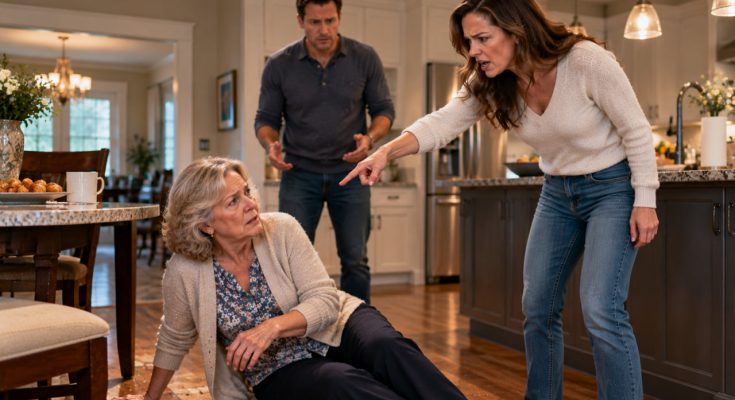
Two weeks after the incident, Liam showed up at my house.
I saw his car through the front window just after four in the afternoon.
He sat behind the wheel for nearly five minutes before getting out.
When he finally approached the front door, he looked tired. His shirt was wrinkled, his hair needed cutting, and there were dark circles beneath his eyes.
I opened the door but remained on the threshold.
“Hi, Mom,” he said.
“Hello, Liam.”
His eyes moved to my wrist.
“How is it?”
“Better.”
He nodded, then looked past me into the house.
“Can I come in?”
I studied his face.
A month earlier, I would have stepped aside immediately. I would have made coffee, asked whether he had eaten, and tried to make him comfortable before he even explained why he was there.
This time, I asked a question.
“Why are you here?”
He looked startled.
“I’m your son.”
“I know.”
“Mom, come on.”
“I’m asking why you came.”
He rubbed the back of his neck.
“The mortgage situation is a mess.”
I felt a familiar ache settle in my chest.
“I see.”
“We’ve lost the property.”
I said nothing.
“The seller wouldn’t wait any longer. The lender couldn’t approve the loan without the original financial support, and we couldn’t come up with enough to make the numbers work on our own.”
“I’m sorry that happened.”
He stared at me.
“That’s all you have to say?”
“What would you like me to say, Liam?”
“That you’re going to help us find another way.”
I took a slow breath.
“You told me to stay away from you.”
His jaw tightened.
“That was a difficult time.”
“It was three weeks ago.”
“Chloe was upset.”
“Chloe hurt me.”
He looked toward the street.
“I know.”
“Do you?”
He didn’t answer.
I continued, keeping my voice calm.
“When I fell, you didn’t come downstairs. When I left, you didn’t ask whether I needed help. A few hours later, you told me to stay away from your family. I went to a clinic alone, Liam. I sat in a waiting room with a swollen wrist and answered questions about what had happened to me.”
He swallowed.
“I didn’t know it was that bad.”
“You didn’t ask.”
The words hung between us.
For a moment, he looked as though he wanted to argue.
Then his shoulders sagged.
“I should have checked on you.”
“Yes.”
“I should have come downstairs.”
“Yes.”
“And I shouldn’t have sent that text.”
“No, you shouldn’t have.”
His eyes filled, but I couldn’t tell whether it was regret or exhaustion.
Perhaps it was both.
“I was angry,” he said. “Everything was happening so fast. Chloe told me you had been criticizing her, and I thought—”
“You thought it would be easier to believe her than to ask me what happened.”
He lowered his head.
“I guess I did.”
I stepped back from the door, not to invite him inside, but to rest my injured wrist against the frame.
“Liam, I love you. That hasn’t changed. But I won’t pay for a house, guarantee a mortgage, or give you money because you are afraid of losing something. If we are going to have a relationship, it has to be built on something other than what I can provide.”
He looked up.
“So you’re just going to abandon us?”
The question hurt more than I expected.
Not because it was fair.
Because it sounded so much like the fear I had carried for years: that if I stopped giving, I would stop mattering.
“No,” I said. “I’m not abandoning you. I’m refusing to abandon myself.”
He stared at me.
For a moment, neither of us moved.
Then he asked, “Can I at least talk to you about Chloe?”
I considered the question.
“You can talk to me when you’re ready to be honest about what happened. But I’m not going to help you explain it away.”
He nodded slowly.
“Okay.”
It was the first time I had heard him use that word without demanding something in return.
He left a few minutes later.
I watched him walk to his car, sit behind the wheel, and stare at the steering wheel before starting the engine.
I wanted to call after him.
I wanted to tell him I was sorry he was hurting.
But I had already spent years rushing to comfort him whenever the consequences of his own decisions became uncomfortable.
This time, I let him feel what he felt.
Sometimes, that is the only way another person can begin to understand the weight of their choices.
I didn’t hear from Liam for another eleven days.
During that time, I began making changes that had nothing to do with him.
I signed up for a watercolor class at the community center.
I started walking with Patricia three mornings a week.
I booked a long-postponed trip to Santa Fe, where my husband and I had once planned to celebrate our thirtieth anniversary before his illness made traveling impossible.
I also met with my financial adviser and reviewed my retirement plan.
For years, I had treated my savings as a resource waiting to be used whenever Liam needed help. Now I looked at the numbers differently.
That money represented the years I had worked.
The nights I had gone without sleep.
The choices I had made to secure my own future.
It represented the possibility of living comfortably without worrying that one unexpected expense would force me to depend on someone else.
I wasn’t going to apologize for protecting it.
Meanwhile, Liam and Chloe had to make decisions of their own.
Without the original mortgage approval, they began looking at smaller properties. They reduced their spending, postponed some of their plans, and tried to understand what they could afford without relying on me.
I didn’t celebrate their difficulties.
I knew how frightening financial uncertainty could be.
But I also knew that helping someone avoid every consequence of their decisions wasn’t always kindness.
Sometimes, it only postponed the moment when they had to grow up.
Then, one Sunday morning, my phone rang.
It was Liam.
I answered.
“Hello?”
“Mom,” he said quietly. “Can I ask you something?”
“Yes.”
“Would you meet me for coffee? Just me. No Chloe. No discussion about money.”
I looked at the calendar hanging beside my refrigerator.
For years, I would have canceled whatever I was doing to make room for him.
This time, I checked my schedule first.
“Thursday at two,” I said. “The little café on Maple Street.”
“Okay.”
“And Liam?”
“Yes?”
“I need you to understand that meeting you doesn’t mean everything is fixed.”
“I understand.”
I hoped he meant it.
But hope, I was learning, was not the same thing as trust.
And trust would have to be earned.
On Thursday afternoon, I arrived at the café five minutes early.
Liam was already there, sitting beside the window with two cups of coffee on the table. When he saw me, he stood up so quickly that his chair scraped against the floor.
For a moment, I saw the little boy who used to run toward me after school, carrying drawings he couldn’t wait to show me.
Then I saw the man who had watched his wife hurt me and later told me to stay away.
Both memories belonged to the same person.
That was the hardest part.
“Hi, Mom,” he said.
“Hello, Liam.”
He pulled out a chair for me. I sat down carefully, still wearing a light wrist brace.
His eyes followed the movement.
“I’m really sorry about your wrist.”
I looked at him.
“Thank you.”
He seemed disappointed that I didn’t immediately reassure him, so he began talking.
“Things have been difficult lately. Chloe and I have been arguing about the house. We thought we had everything figured out, and then the lender changed everything.”
“The lender didn’t change everything, Liam. Our financial arrangement changed.”
He nodded.
“You’re right.”
For several minutes, he stared at his coffee.
Then he finally said what I had been waiting to hear.
“I should have come downstairs.”
I didn’t respond.
“I heard the argument,” he continued. “I heard the noise when you fell. I knew something had happened, but I stayed upstairs because Chloe told me to give her a minute to calm down.”
My stomach tightened.
“You heard me fall?”
He closed his eyes briefly.
“Yes.”
“And you stayed upstairs?”
“Yes.”
The café suddenly seemed quieter, although the espresso machine was still hissing behind the counter and people were talking at nearby tables.
I had imagined many explanations for his silence.
I had hoped he hadn’t heard.
I had told myself he might have been wearing headphones or taking an important work call.
But the truth was worse.
He had heard something happen to his mother, and he had chosen not to investigate.
“Why?” I asked.
He rubbed his palms together.
“Because I didn’t want another fight. Chloe said you were making her feel attacked, and she was furious. I thought if I stayed out of it, things would settle down.”
“And when I left?”
“I assumed you were going home.”
“I was injured, Liam.”
“I know.”
“No, you know now. At the time, you didn’t care enough to find out.”
His face crumpled.
“I was wrong.”
For the first time since the incident, I believed he understood at least part of what he had done.
But understanding was only the beginning.
“I spent years trying to make sure you never felt alone,” I told him. “When your father died, I was devastated, but I still got up every morning because you needed me. When you struggled financially, I helped. When you wanted this house, I gave you my financial information because I believed I was helping you build a stable future.”
“I know, Mom.”
“Do you? Because I don’t think you ever understood what that help meant to me. I wasn’t simply giving you money. I was trusting you.”
He looked down.
“And when I needed you to show me the smallest amount of concern, you sent me a text telling me to stay away.”
His eyes filled with tears.
“I’m sorry.”
I wanted to embrace him.
That instinct was so deeply rooted that I had to remind myself to stay still.
I could love my son without pretending the damage hadn’t happened.
“I need you to understand something,” I said. “An apology doesn’t mean I can immediately trust you again. It means you have the opportunity to start earning that trust.”
He nodded.
“I understand.”
“Then tell me what you’re going to do differently.”
He opened his mouth, then closed it.
For once, I wasn’t going to supply the answer for him.
Finally, he said, “I’m going to stop expecting you to fix everything. And I’m going to stop letting Chloe decide how I treat you.”
I studied his face.
“That sounds good. But I need to see it, not just hear it.”
“I know.”
We finished our coffee without discussing the mortgage again.
When we stood to leave, Liam asked whether he could hug me.
I hesitated before stepping forward.
His arms wrapped around me carefully, avoiding my injured wrist.
I held him for a few seconds.
Then I stepped back.
It wasn’t forgiveness in its entirety.
It was a beginning.
And beginnings, I was learning, didn’t require me to forget what had happened.


One Comment on “PART 4 – My Son Told Me to Stay Away After His Wife Injured Me—Then the Mortgage Lender Called Him”