PART 3
My name appeared on every other page.
My credit history. My income statements. My retirement account balances. The financial disclosures I had submitted because Liam and Chloe had insisted they only needed a little help to get their dream house.
A beautiful two-story property with a wide front porch, a fenced backyard, and enough bedrooms for the children they said they wanted someday.
They had shown me the listing over dinner three months earlier.
Chloe had turned her phone toward me, her eyes bright with excitement.
“Look at the kitchen, Margaret. Can you imagine Thanksgiving here? A huge table, everybody together, the grandchildren running around?”
I was sixty-two years old, widowed for nine years, and I had spent most of my adult life making sure my son never had to experience the kind of financial uncertainty I had known growing up.
After my husband died, I worked extra shifts, postponed vacations, and learned to repair things around my house instead of paying someone else to do them. Every bonus went into savings. Every tax refund became another deposit into the account I had mentally labeled Liam’s Future.
I never told him how many evenings I sat alone eating leftovers because I wanted him to have money for college.
I never mentioned the vacations I skipped so he could attend summer programs.
And when he graduated, found a decent job, and married Chloe, I thought my sacrifices had finally paid off.
Then the house came along.
Their mortgage lender had explained that Liam and Chloe could qualify for the property if I agreed to support the application. My income and credit history would strengthen their file, and I had initially believed I was merely helping them cross the final hurdle.
I hadn’t planned to buy their house for them.
I hadn’t planned to become responsible for their future.
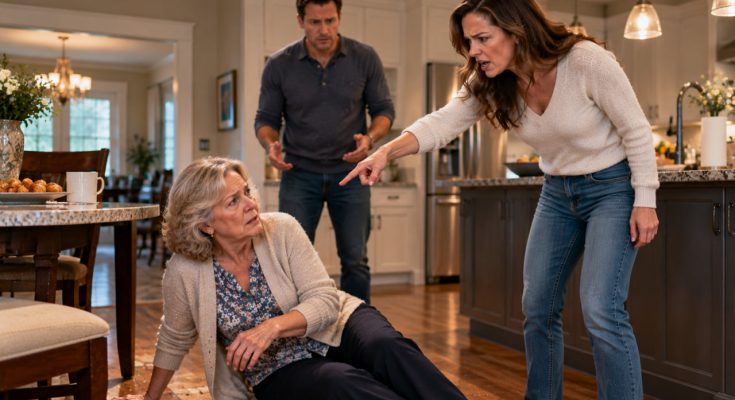
I certainly hadn’t planned to be shoved to the floor in their kitchen and told I was no longer welcome.
Yet here I was.
At 10:21, my phone vibrated again.
This time, I looked at the screen.
LIAM: Mom, we need to talk. Call me immediately.
I read the message twice.
Then I placed the phone back on the table.
For the first time in years, I didn’t feel the familiar urge to fix whatever was wrong in my son’s life.
I felt something quieter.
Relief.
Because whatever happened next, I no longer had to pretend that loving Liam meant agreeing to everything he wanted.
At 10:34, a new message arrived.
LIAM: The bank says something changed with the mortgage application. Did you do something?
I took a slow breath.
I could have explained everything. I could have reminded him that he had asked me to stay away, that his wife had hurt me, and that he had chosen silence when I was lying on the floor.
ME: I respected your request to stay away. Please respect mine.
I sent it.
Then I turned my phone off.
For the rest of that morning, I did something I hadn’t done in years.
I made plans for myself.
I called my doctor to arrange a follow-up appointment for my wrist. I contacted my attorney, Daniel Reeves, who had helped me settle my husband’s estate, and requested a meeting to review the financial documents connected to the house.
I didn’t ask Daniel how I could punish my son.
I asked him how I could protect myself.
That distinction mattered.
Because withdrawing financial support wasn’t about revenge. It was about refusing to keep putting my future at risk for people who had made it painfully clear that my presence was unwanted.
Daniel listened without interrupting while I explained what had happened.
When I finished, he took off his glasses and folded his hands on the desk.
“Margaret, I want to make sure I understand,” he said. “Your daughter-in-law physically struck you, you suffered an injury, and your son subsequently instructed you not to contact or visit them?”
“That’s correct.”
“And you want to withdraw your financial involvement in their pending mortgage application?”
“Yes.”
He nodded slowly.
“Then we’ll review exactly what you’ve signed, what commitments remain outstanding, and what the lender will permit. We need to make sure you don’t accidentally violate an agreement or expose yourself to liability.”
I appreciated that he didn’t promise me an easy solution.
He simply helped me understand my options.
By the end of the meeting, I had a clear picture of what needed to happen next. The mortgage had not closed, and my attorney would communicate with the lender to clarify the status of my involvement. Any release would have to be handled according to the lender’s procedures and the documents I had signed.
It wasn’t a magic button.
It was a legal and financial decision that needed to be handled carefully.
But the essential truth remained the same.
I was no longer willing to offer financial support on the assumption that my son would always treat me with love and respect.
As I left Daniel’s office, he walked me to the door.
“One more thing,” he said.
I turned.
“Please document what happened at the house. Keep the medical paperwork. Save the messages. If you decide to report the assault, those records may be important.”
I nodded.
“I will.”
On the drive home, I passed a little bakery where my husband used to buy cinnamon rolls every Sunday morning.
For a moment, I nearly pulled into the parking lot.
Then I remembered how he used to tease me for saving the best part of every meal until last.
“Margaret,” he would say, “you can’t spend your whole life saving the good things for later.”
I smiled sadly.
He had been right.
I had spent so many years putting my own happiness last that I had forgotten it was allowed to come first.
That afternoon, I bought myself a cinnamon roll.
I ate it at my kitchen table, slowly, without checking my phone.
It was a small thing.
But it was mine.
And for the first time since Chloe had struck me, I felt as though I was beginning to reclaim something that belonged to me.
My dignity.
Across town, Liam was discovering that a house could become a very expensive symbol of a life that wasn’t working the way he had imagined.
He called the loan officer again just before noon.
According to the message he later left me, the lender needed to reassess the application because my financial support was no longer available in the form originally submitted.
Without my backing, Liam and Chloe no longer met the lender’s requirements for the mortgage they had requested.
Their debt-to-income ratio was too high, their available reserves were lower than required, and their application couldn’t proceed under the existing terms.
The loan officer explained that they might qualify for a smaller loan, provided they made changes to their finances and submitted a new application.
Liam apparently asked whether the lender could simply ignore the change.
The answer was no.
He then asked whether I could be persuaded to reconsider.
The answer to that question was also no—not because the lender had forbidden me from helping, but because I had made my own decision.
When Liam finally reached Chloe, he was furious.
“Did you call my mother?” she asked.
“No. Why would I call her? She knows what she did.”
“What she did?” Liam repeated. “Mom was the one who got hurt.”
Chloe went silent.
According to Liam, that was when the argument began.
She insisted that I had provoked her. She claimed I had been interfering in their marriage, criticizing her spending, and making her feel as though she owed me something.
Liam demanded to know why she hadn’t mentioned any of that before.
“Because you weren’t there,” she snapped.
That was the first time he apparently asked the question that had been hanging between them since the incident.
“Then tell me exactly what happened.”
Chloe gave him a version of the story.
She said I had questioned their mortgage, criticized their financial decisions, and told her she wasn’t good enough for him.
She claimed she had only pushed me away because I was getting too close.
But there was one detail she couldn’t explain.
Why had she left me on the floor?
Why hadn’t she called for Liam?
Why had she walked away without even asking whether I was injured?
Liam later told me that he hadn’t wanted to believe what those questions suggested.
He had spent years convincing himself that any conflict between his mother and his wife was simply a misunderstanding.
If Chloe was upset, he tried to calm her.
If I was hurt, he asked me to be patient.
If the two of us disagreed, he told me not to make things harder for him.
It had been easier to keep everyone quiet than to decide who was right.
But silence had consequences.
And this time, his silence had cost him more than he had expected.
Three days passed before I heard from Chloe.
Her first message arrived on a Thursday evening.
CHLOE: I think we should clear the air. Things got out of hand.
I read it while sitting in my living room, my injured wrist resting on a cushion.
Things got out of hand.
The words were so ordinary that I almost laughed.
As though a glass had broken.
As though someone had raised their voice at dinner.
As though I had accidentally offended a guest.
Not as though she had struck me hard enough to send me stumbling into a table.
I didn’t reply.
An hour later, another message arrived.
CHLOE: Liam is under a lot of stress right now. You know how important this house is to us.
There it was.
Not Are you okay?
Not I’m sorry I hurt you.
Not even I shouldn’t have done that.
The house.
Their dream.
Their plans.
Their future.
Everything except the person she had injured.
I placed the phone in a drawer.
The next morning, I received a call from my neighbor, Patricia.
She had seen me return from the clinic earlier in the week and had been worried when she noticed the splint on my wrist.
“Margaret, sweetheart, are you all right?” she asked.
I hesitated.
For years, I had perfected the habit of saying I was fine before anyone could ask a second question.
But something about her voice made the truth easier to tell.
So I told her.
Not every detail, and not dramatically. I simply explained that Chloe and I had argued, that she had become physical with me, and that I had ended up injured.
Patricia was quiet for a moment.
Then she said, “I’m sorry. You shouldn’t have to carry that alone.”
Those words nearly brought me to tears.
Not because they were extraordinary.
Because they were so simple.
She didn’t ask what I had done to upset Chloe.
She didn’t tell me to forgive her for the sake of the family.
She didn’t remind me that Liam was my only child.
She simply believed that what happened to me mattered.
That afternoon, Patricia came over with soup and a loaf of bread.
We sat at my kitchen table and talked about ordinary things—her garden, the neighborhood association, the ridiculous price of groceries.
For the first time in several days, I laughed without feeling guilty.
When she left, I realized how much of my life I had organized around being needed by Liam.
I had measured my usefulness by how quickly I could solve his problems.
I had treated his emergencies as my responsibilities and his disappointment as something I needed to repair.
I had mistaken being indispensable for being loved.
And I had done it for so long that I barely noticed.
That evening, I opened the spare bedroom where I kept boxes of old family photographs.
I found one of Liam at eight years old, sitting on his father’s shoulders at a county fair. His face was sticky with cotton candy, and he was laughing so hard his eyes were nearly closed.
I held the photograph for a long time.
I still loved that boy.
I loved the young man he became.
I loved the son I had raised, the son I had watched graduate, the son who once brought me flowers after I worked through a terrible winter with the flu.
But loving him didn’t mean I had to accept the way he was treating me now.
The boy in that photograph would have been horrified to see his mother sitting alone with an injured wrist because his wife had hurt her.
I couldn’t know whether the man he had become would ever understand that.
But I knew what I needed to do.
I needed to stop using my love for him as a reason to abandon myself.
The following Monday, my attorney called with an update.
The lender had acknowledged the change in my financial involvement. Because the mortgage had not closed, my withdrawal could be addressed before any final loan documents were executed, subject to the terms and approvals involved.