PART 4
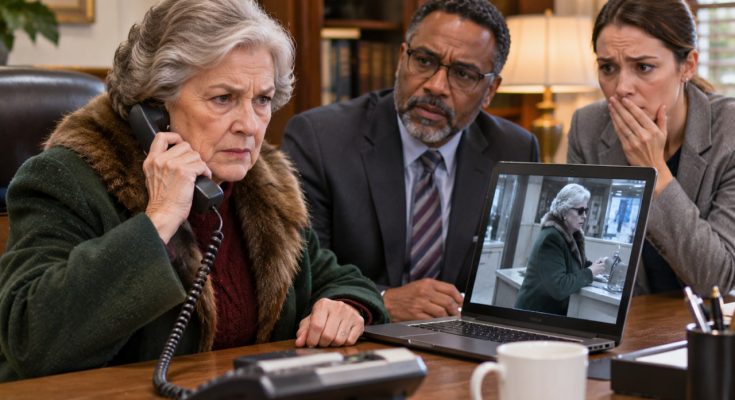
The telephone conversation.
And Diane’s unexpected return to the bank.
When I finished, Detective Harris opened her notebook.
“Mrs. Lane, I need to ask you something. Has anyone recently visited your home when you weren’t there?”
I thought for a moment.
“Brian has a spare key.”
“Anyone else?”
“My daughter sometimes comes by. The cleaning lady comes every Wednesday.”
“Have you noticed anything missing?”
I almost said no.
Then I remembered something.
“My husband’s documents.”
Detective Harris looked up.
“What documents?”
“His old financial papers. Insurance documents. Property records. A small folder he kept in his study.”
“Are those documents missing?”
She exchanged a glance with the other officer.
“Would you be comfortable allowing us to help you check?”
I agreed.
Before leaving the bank, Mr. Okafor gave Detective Harris copies of the relevant transaction records and confirmed that the security footage had been preserved.
He also arranged for my remaining accounts to be secured.
I went home with the officers.
The house looked exactly as I had left it.
The little clock above the fireplace still showed the wrong time. My husband’s photograph remained beside the television. A half-finished crossword puzzle sat on the dining table.
Everything was familiar.
And yet, for the first time in fifty-five years, I felt like a stranger inside my own home.
Detective Harris accompanied me into the study.
The old wooden filing cabinet stood against the wall.
I opened the bottom drawer.
The folder was gone.
I searched behind the books, beneath the desk, and inside the cupboard.
Nothing.
“What was in it?” she asked.
“Insurance papers. My husband’s pension documents. The original deed to the house. And a letter.”
“What letter?”
I swallowed.
“A letter my husband wrote before he died.”
I had not read that letter in years.
My husband, Robert, had been a careful man. He kept records of everything. He believed that a person should leave their family with clear instructions, especially when money was involved.
After his death, I had put the letter away because reading it hurt too much.
I had assumed it was simply a personal goodbye.
But now the folder was missing.
Detective Harris asked whether I had a copy.
“I might.”
We searched the bedroom closet.
Eventually, inside a small box of Christmas cards, I found an envelope with Robert’s handwriting.
My hands began to tremble.
I opened it.
The letter was short.
It contained a few affectionate words, then a paragraph about our finances.
He had written that a separate investment account existed in addition to our ordinary savings.
The account was not part of the money I had withdrawn for daily expenses.
It was a reserve he had created for our daughter, intended to be released when she reached a particular age, provided certain conditions were met.
Then a third time.
“Detective,” I said quietly, “I don’t think they knew about the sixty-one thousand dollars only.”
She looked at the letter.
“Do you know where this account is?”
I shook my head.
“Not exactly. Robert handled most of the investments. I remember him saying he had arranged everything through an attorney.”
The detective asked whether I had the attorney’s name.
I looked at the bottom of the letter.
There it was.
A name and an old office telephone number.
The next morning, Detective Harris helped me contact the law firm.
The attorney had retired, but his former partner was still working there.
After verifying my identity, he agreed to meet with us.
I arrived at his office with Robert’s letter inside my purse.
The attorney, Mr. Collins, was a thin gentleman with silver glasses. He read the letter slowly.
Then he removed his glasses.
“Mrs. Lane, I wondered whether this day might eventually come.”
I felt cold.
“What do you mean?”
He opened a cabinet and removed a thick file.
“Your husband established an investment trust many years ago. The arrangement was designed to protect the principal and provide for your daughter’s future.”
“How much money?”
He looked at me.
“The original investment has grown considerably. According to the last statement in our file, the trust was valued at approximately $184,000.”
I sat back.
One hundred and eighty-four thousand dollars.
I had never known the exact amount.
“Who controls it?”
“Your husband appointed you as the primary trustee. Your daughter is the intended beneficiary, subject to the conditions in the trust.”
I stared at him.
“Can she withdraw money?”
“Not without your authorization. And there are restrictions on changing the beneficiary.”
I slowly understood.
Brian and Diane had not simply taken money from my ordinary savings.
They might have been searching for access to the trust.
Mr. Collins continued.
“Your husband also left a specific instruction. He wanted the trust protected from anyone attempting to obtain control through pressure, deception, or unauthorized signatures.”
I felt tears gather in my eyes.
Robert had known how easily family relationships could become complicated when money was involved.
He had tried to protect us.
And somehow, the people I trusted most had attempted to break through that protection.
Detective Harris asked Mr. Collins to preserve the trust documents and provide the appropriate records to the investigators.
Then she turned toward me.
“Mrs. Lane, I think we have a much clearer picture now. But I need to establish exactly what your family knew about this account.”
I looked down at Robert’s letter.
“Then you should ask Diane.”
That afternoon, the police contacted her.
She initially denied knowing anything about my identification.
But when investigators showed her the security footage, her story changed.
She admitted wearing my coat.
She admitted visiting the bank.
And eventually, she admitted that Brian had given her my identification.
She claimed she had believed I had authorized the withdrawals.
But the investigators had another question.
Why had she returned to the bank after the theft was discovered?
Her answer changed everything.
She said Brian had told her to find out whether the account was frozen because they needed to know how much time they had left.
Time for what?
The answer came two days later.
Brian had been receiving calls from a private lender.
The kitchen renovation was not fully paid for.
There were credit card debts, overdue payments, and another loan he had never told my daughter about.
The house they had been living in was at risk.
The new kitchen, the expensive appliances, the beautiful countertops, the polished cabinets—all of it had been financed with money they did not have.
The sixty-one thousand dollars had gone toward those debts.
But there was more.
Investigators discovered that Brian had been trying to obtain documents relating to Robert’s trust.
He had apparently learned that my husband had left something valuable behind.
He wanted access.
And he had been using my daughter to get close enough to the information.
When Detective Harris told me, I felt an enormous sadness.
Not because Brian had fooled me.
But because my daughter had lived in that house, watched that renovation, and apparently never asked how they could afford it.



One Comment on “PART 4 – I Went to Withdraw $300 for My Grandson—Then the Bank Teller Asked Why I’d Been There 3 Times That Week”