PART 3
“Sweetheart,” I said quietly, “what exactly do you think I’m about to do?”
My daughter exhaled sharply.
“Mom, you’re making a mistake. You don’t understand what’s happening. Brian can explain everything.”
“Then put Brian on the phone.”
Another silence.
I heard a door closing somewhere in the background. Then muffled voices. A man’s voice, unmistakably Brian’s, asked something I couldn’t quite make out.
My daughter whispered something back.
A few seconds later, Brian came onto the line.
“Mrs. Lane,” he began, using the formal name he normally reserved for arguments. “I think we should all calm down.”
I almost laughed.
I had even trusted him with a spare house key.
Now he was telling me to calm down after sixty-one thousand dollars had disappeared from my account.
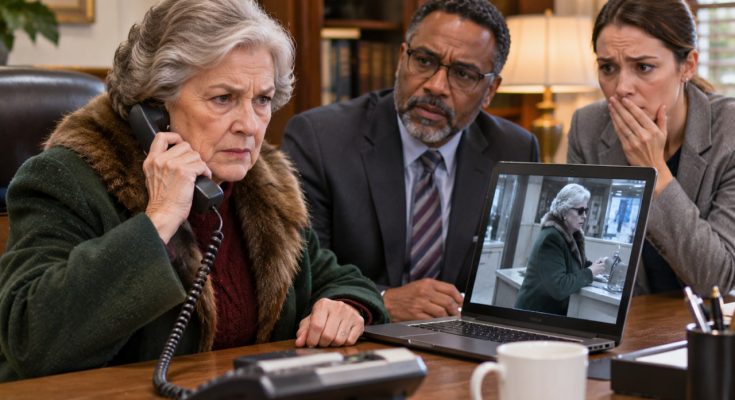
“Brian, I have a simple question. Why is Diane wearing my green coat at my bank?”
He didn’t answer immediately.
Then he said something that made my stomach tighten.
“She was helping us.”
“Helping you do what?”
“Mom, please,” my daughter interrupted. “We were going to tell you.”
“Tell me what?”
The silence returned.
I glanced at Mr. Okafor. He was quietly taking notes.
Finally, Brian spoke.
“We borrowed the money.”
“Borrowed?”
“Yes. We were going to put it back.”
I closed my eyes.
“Sixty-one thousand dollars is not money you borrow from someone without asking.”
“We had a situation,” he replied defensively. “The renovation was more expensive than expected. We had some debts. Things got out of control.”
“And Diane?”
He hesitated.
“She suggested a way to help.”
I looked again at the security photograph.
“By dressing like me?”
Nobody answered.
I continued.
“By taking my identification? By pretending to be an eighty-year-old woman who has banked at the same branch for fifty-five years?”
My daughter’s voice suddenly cracked.
“Mom, she said nobody would notice. She said you never checked your account online.”
That sentence hurt more than I expected.
Not because I was ashamed of not checking my account.
But because they had discussed my habits.
They knew when I visited the bank. They knew I kept paper statements in a drawer. They knew I trusted familiar faces.
They had turned everything that made me comfortable into a plan.
“How did Diane get my identification?” I asked.
My daughter began crying.
I waited.
“Brian took it,” she finally whispered.
My fingers tightened around the telephone.
“When?”
“Last month. When he came over to fix your kitchen cabinet. He said he needed to check something on your account because you had asked him to help with your paperwork.”
I remembered that afternoon.
Brian had spent almost an hour in my kitchen. He had made me tea. He had asked about my medication, my groceries, and whether I had been sleeping well.
I had even thanked him for being such a thoughtful son-in-law.
“Did he take my coat, too?”
This time, Brian answered.
“Mom, Diane borrowed it. She needed something that looked similar to you.”
“Similar?”
He said nothing.
I turned toward Mr. Okafor.
“Please document that statement.”
He nodded.
Then I asked the question I had been avoiding.
“Was my daughter involved in the withdrawals?”
My daughter started sobbing.
“Mom, I didn’t stand at that counter. I swear I didn’t.”
It was not an answer.
“That isn’t what I asked.”
She struggled to speak.
“I knew Diane was going to the bank. I knew they were trying to get money. But Brian told me it was something you had agreed to.”
“And you believed him?”
“I wanted to believe him.”
I felt something inside me change.
My daughter had not simply been kept in the dark. She had seen enough to know something was wrong, and she had chosen not to ask questions.
“Listen carefully,” I said. “I am not giving anyone permission to touch another dollar of my money. The bank is contacting the authorities. You will not come to my house. You will not move anything from my accounts. And from this moment forward, everything goes through the police and my attorney.”
“Mom, please don’t destroy our family over this.”
I looked at the security photograph one final time.
“Sweetheart, I didn’t destroy our family. Someone decided my savings were worth more than my trust.”
Then I ended the call.
For several seconds, nobody spoke.
Mr. Okafor finally placed a hand on the desk.
“Mrs. Lane, I want you to know that we will preserve all the relevant records. We will also contact our fraud department immediately.”
I nodded.
“Thank you. But I want something else.”
“Of course.”
“Nobody is allowed to tell them what I do next.”
He looked puzzled.
I leaned forward.
“Because I have a feeling this was not the first time they tried to take something from me.”
And I was right.
Because when the bank’s fraud investigator examined the previous months of activity, he discovered something far more disturbing than the missing sixty-one thousand dollars.
There had been a test.
Three months earlier, someone had attempted to change my mailing address.
The request had been rejected because the signature did not match.
Two weeks later, someone had called the bank asking about the withdrawal limits on my account.
The employee had refused to provide the information.
And then, six days before I walked into that branch, someone had successfully obtained access to my account information.
The investigator printed the records and placed them in front of me.
There was a telephone number associated with one of the inquiries.
I recognized the last four digits.
They belonged to my daughter’s house.
I slowly pushed the paper away.
“Mr. Okafor,” I whispered, “I think we need to find out how long this has been happening.”
He nodded.
And then his phone rang.
He listened for a moment, his expression becoming increasingly serious.
When he hung up, he looked directly at me.
“Mrs. Lane, the police are on their way. But there’s something else.”
“What?”
“The woman in the footage came back yesterday.”
My heart stopped.
“Yesterday?”
“Yes. She didn’t make a withdrawal. She spoke to one of our employees and asked whether your account had been temporarily restricted.”
I looked at the photograph again.
Diane had known the theft was discovered.
Yet she had returned.
And she had asked whether I could still access my money.
That was when I realized something.
They weren’t simply trying to steal my savings.
They were afraid I was about to discover something else.
Something they had not managed to erase.
THE SECRET HIDDEN BEHIND THE $61,000
The police arrived forty minutes later.
Two officers came into Mr. Okafor’s office. One introduced herself as Detective Harris. She was probably in her late forties, with tired eyes and a calm voice.
She listened without interrupting while I explained everything.
The missing money.
The green coat.
The stolen identification.