PART 3
I sat straighter in my chair.
“What happened?”
“Yesterday afternoon, Theo asked his teacher if grandparents could stop loving their grandchildren because they had done something wrong.”
I closed my eyes.
For several seconds, I couldn’t speak.
Patricia continued gently.
“He became very upset when his teacher asked what he meant. He said his grandmother didn’t want him anymore because she refused to take care of him.”
My hand tightened around the phone.
“Oh, sweetheart…”
“Mrs. Miriam, I know this is a sensitive family matter, and I don’t want to interfere. But Theo has mentioned you several times. He talks about your dinosaur pancakes and the little garden where you grow tomatoes. Yesterday, he asked whether he could send you a drawing.”
Tears filled my eyes.
“Did he say anything else?”
“Yes. He asked whether you were still sick.”
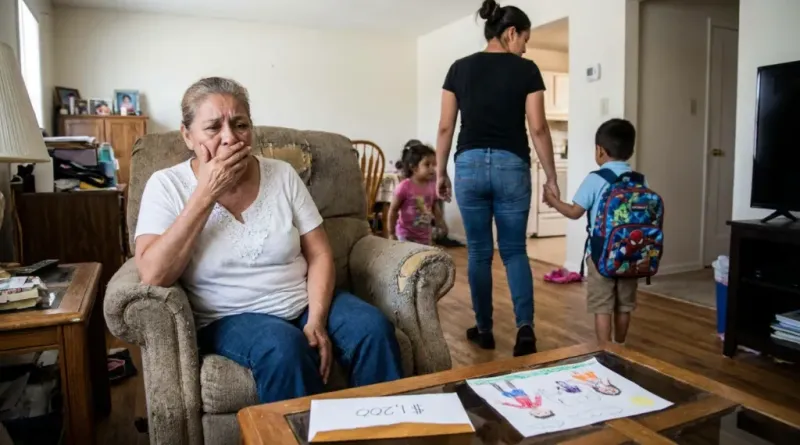
I covered my mouth.
For weeks, I had imagined Celeste explaining my absence to the children.
I had hoped she would tell them the truth in a way their young minds could understand.
I had never imagined my grandson believing that I had deliberately abandoned him.
“Can I speak to him?” I asked.
Patricia hesitated.
“Unfortunately, we cannot arrange private contact without parental permission. But I wanted you to know because he seems to be carrying a lot of sadness.”
“Thank you for calling.”
After we hung up, I remained in my chair.
Naomi entered the kitchen carrying a grocery bag.
She immediately noticed my expression.
“What happened?”
I told her everything.
She put the groceries down.
“That’s emotional manipulation, Aunt Miriam.”
“She’s his mother.”
“Being his mother doesn’t make it right to make a six-year-old believe he’s unwanted.”
I looked at the framed photograph on the bookshelf.
It showed Theo sitting on Samuel’s shoulders at the lake house, holding a fishing rod almost as long as he was.
Samuel was laughing.
Theo was laughing.
And I remembered how Samuel used to say that children should never be forced to carry the weight of adult disagreements.
“Naomi,” I whispered, “I need to know something.”
“What?”
“Do you think Celeste really believes I abandoned those children?”
Naomi pulled out a chair.
“I think she knows you couldn’t physically care for them. But I don’t think that’s the real reason she’s so angry.”
I turned toward her.
“What do you mean?”
She hesitated.
Then she said something that stayed with me for the rest of the day.
“I think your first real no has frightened her because she’s beginning to realize she can’t control what happens when you stop rescuing her.”
I wanted to disagree.
I wanted to defend my daughter.
But I couldn’t.
Because somewhere inside me, I knew Naomi might be right.
That afternoon, I called Leonard Pike.
“I’ve made a decision,” I told him.
“All right. What would you like to do?”
“I want to protect the children. I also want to protect myself.”
“Those are reasonable goals.”
“I don’t want Celeste to lose everything. But I don’t want my remaining years to become a financial emergency service for her household.”
Leonard chuckled softly.
“I believe Samuel would approve of that description.”
For the first time in weeks, I smiled.
We arranged another appointment for the following Monday.
This time, I wasn’t going to his office to ask whether I had permission to protect my savings.
I was going to make decisions about my own future.
Before hanging up, Leonard asked me something.
“Have you considered whether the $171,640 you documented might be connected to your daughter’s recent behavior?”
“What do you mean?”
“Some families become uncomfortable when financial assistance is documented.
Especially when they have spent years treating it as something that never needs to be discussed.”
I stared at the cedar box.
“Are you suggesting she thinks I’m going to ask for the money back?”
“I’m suggesting we should understand the situation before making assumptions.”
After the call, I opened Samuel’s old records again.
I had already calculated the total.
But this time, I examined the dates.
Most of the large payments had occurred during the first eight years of Celeste’s marriage.
There were periods when everything seemed stable.
Then, suddenly, another emergency.
A medical bill.
A car repair.
A temporary job loss.
An unexpected property expense.
And almost every time, the same sentence appeared in Samuel’s handwriting.
Celeste says she will repay us next month.
I turned another page.
Then another.
Something caught my attention.
A payment of $32,000 had been recorded as the down payment for Celeste and Derek’s first home.
But beside it, Samuel had written something unusual.
Temporary assistance. Ownership and repayment arrangement to be confirmed.
I frowned.
I remembered that payment.
Celeste had called us crying because the bank needed additional funds before closing. Samuel and I had transferred the money because we wanted our daughter to have a safe home.
But I couldn’t remember ever receiving a repayment agreement.
I searched through the folder.
Nothing.
Then I found a small envelope tucked inside the back cover.
On it, Samuel had written:
PROPERTY CONTRIBUTION — KEEP WITH ORIGINAL CLOSING DOCUMENTS.
My fingers trembled as I opened it.
Inside was a photocopy of a bank transfer confirmation, a handwritten note, and a letter from the attorney who had handled the property purchase.
The letter was dated thirteen years earlier.
I read it once.
Then again.
The document indicated that the $32,000 had been recorded as a family loan, not an unconditional gift.
It also referenced a signed acknowledgment from Derek and Celeste.
I stared at the signature line.
Both of their names were there.
For years, I had believed that Samuel and I had simply given them the money.
Apparently, Samuel had been more careful than I realized.
I placed the papers on the table.
Then I called Leonard.
“I think I’ve found something.”
The following Monday, Naomi drove me to Leonard’s office.
My back was improving, although I still walked slowly and needed a cane for longer distances.
Leonard greeted us at the entrance.
He had already prepared several folders.
“Mrs. Miriam, I’ve reviewed the documents you sent.”
He pointed to the chair opposite his desk.
“There’s something important we need to discuss.”
I sat down.
“Is it about the house?”
“Yes.
The original agreement is legally significant, although we’ll need to verify the current title and review the complete closing records before drawing conclusions.”
He opened a folder.
“According to the acknowledgment signed by Celeste and Derek, the $32,000 was intended as a repayable family loan. It wasn’t recorded as a gift.”
Naomi leaned forward.
“How much is still owed?”
Leonard looked at the documents.
“Based on the records currently available, the full amount appears unpaid. We also have other documented loans totaling $6,600.”
I swallowed.
“So the $38,600 Samuel recorded was accurate?”
“It appears so, subject to final verification.”
I looked at the papers.
For years, I had told myself that I didn’t care about the money.
And I still didn’t want it back because I needed it.
I wanted it back because I was beginning to understand that my daughter had rewritten our family’s history.
Every time I helped, she remembered the help as something she was entitled to receive.
Every time I mentioned a boundary, she remembered it as an act of cruelty.
And now she was telling my grandson that I didn’t love him because I couldn’t lift him.
Leonard removed his glasses.
“There’s another matter.”
I looked up.
“What?”
“Your daughter recently contacted my office.”
My stomach tightened.
“Celeste?”
“Yes.”
“When?”
“About ten days ago.”
Naomi immediately looked at me.
“Why didn’t you tell us?”
Leonard raised a hand gently.
“I hadn’t yet confirmed whether the information was relevant. She asked whether any changes had been made to your estate planning documents.”
I stared at him.
“Why would she ask that?”
“She said she was concerned that your health situation might have affected your judgment.”
I felt something cold move through my chest.
“My health?”
“She mentioned your upcoming surgery and suggested that you might be making financial decisions while emotionally vulnerable.”
Naomi shook her head.
“Unbelievable.”
I tried to understand.
Celeste had not called to ask whether I survived surgery.
She had not asked whether I could walk.
She had not asked whether Naomi was getting enough sleep while caring for me.
But she had contacted my attorney to ask about my inheritance plans.
“Did you tell her anything?”
“Absolutely not. You’re my client. I did not disclose your private legal information.”
I nodded.
Then I asked the question that had been bothering me.
“Did she ask specifically about the lake house?”
Leonard looked at me.
“Yes.”
For a moment, nobody spoke.
The lake house.
Samuel’s favorite place.
The property where Celeste had spent every summer of her childhood.
The property she had always assumed would eventually become hers.
I looked down at my hands.
“She thinks she’s going to inherit it.”
Leonard nodded.
“That appears to be her expectation.”
I breathed slowly.
“Then I think it’s time she understands that an inheritance is not something a person can demand.”
Two days later, something happened that I had not expected.
I received a package from Derek’s mother, Eleanor.
Eleanor and I had always maintained a polite relationship.
She was a quiet woman in her early seventies who had spent much of the previous year caring for her husband after his stroke.
She rarely involved herself in disagreements between Celeste and Derek.
In fact, she had always seemed grateful whenever Samuel and I helped with the children.
The package contained a small envelope.
Inside was a handwritten note.
Miriam, I hope your surgery went well. I have wanted to contact you for several days, but I wasn’t sure whether it would make things worse.
There is something you should know about the Charleston trip.
I read the note twice.
Then I called her.
She answered after the second ring.
“Miriam?”
“Eleanor, I received your letter.”
There was a long silence.
Then she sighed.
“I didn’t know how to tell you.”
“Tell me what?”
“That Charleston isn’t the real reason Celeste became angry.”
I sat down.
“What do you mean?”
“Two weeks before she called you, Derek told me that he was having financial difficulties.”
I waited.
“He said he had made a mistake with money. Something involving an investment and a personal loan. He asked whether I could help.”
“How much?”
“Forty thousand dollars.”
My eyes widened.
“Forty thousand?”
“Yes. I couldn’t give him that kind of money. My husband needs ongoing care, and most of our savings are reserved for medical expenses.”
I felt a familiar pressure in my chest.
“Did he tell you what the money was for?”
“He said he needed to cover an urgent payment before the end of the month.
When I asked more questions, he became defensive.”
I looked toward Naomi, who was sitting across the room reading.
“Eleanor, what does this have to do with me?”
Her voice became quieter.
“Because I heard Celeste talking to Derek on the phone the following evening.”
“What did she say?”
“I didn’t hear the entire conversation. But I heard her say, ‘Your mother won’t help, and my mother is our last option.’”
I closed my eyes.
My mother is our last option.
Then Eleanor continued.
“She also said something about your lake property.”
I sat completely still.
“What about it?”
“I heard her say, ‘Once everything is settled, the lake house will be ours anyway.’”
My hand tightened around the phone.
Eleanor began crying.
“Miriam, I don’t know what they’re planning. I don’t want to accuse my son of something terrible.
But I thought you deserved to know.”
I thanked her.
Then I remained seated for a long time.
Naomi finally put down her book.
“What happened?”
I told her.
She didn’t interrupt.
When I finished, she stood and walked to the window.
“Aunt Miriam, I think you need to stop assuming this is just about babysitting.”
I looked at her.
“You’re right.”
For the first time, I said it without defending Celeste.
The next morning, I made three phone calls.
The first was to Leonard.
I asked him to begin the process of reviewing and updating my estate plan, including the possibility of placing the lake property into a properly structured trust for Theo and Wren.
I wanted independent trustees.
I wanted clear restrictions.
And I wanted neither Celeste nor Derek to have the authority to borrow against the children’s inheritance.
The second call was to my bank.
I requested a review of all recurring transfers, authorized payments, and financial arrangements connected to Celeste and Derek.
I discovered something I had overlooked.
For nearly eighteen months, I had been paying their home insurance directly.
The monthly amount was $186.
I had also been covering a $340 monthly payment toward their vehicle insurance and a $125 subscription package that Celeste had once asked me to maintain temporarily while Derek was between jobs.
None of those arrangements had ever been discussed again.
I canceled the payments that were still active, after confirming the terms with the providers.
The third call was to the real estate attorney who had handled the lake house.
I wanted to know exactly what would happen if I sold the property.
He explained the process and agreed to review the title, tax records, and any existing claims.
I wasn’t selling it immediately.
But I was no longer treating it as an inheritance waiting for Celeste’s approval.
It was my property.
Samuel and I had worked for it.
And I had every right to decide what happened to it.
Three days later, I received another message from Celeste.
It was the first direct communication from her since the certified letter.
“Mom, Derek and I need to talk about something important. We have a family situation, and we really need your help. Please don’t make this more difficult than it needs to be.”
I read it twice.
There was no apology.
No question about my recovery.
No mention of Theo asking about me.
Just another request.
I didn’t answer immediately.
Instead, I placed my phone on the table and continued preparing lunch.
An hour later, another message arrived.
“Mom, this is serious. We need $40,000. We wouldn’t ask if it weren’t necessary.”
I stopped moving.
Forty thousand dollars.
Exactly the amount Eleanor had mentioned.
I felt my heart beating faster.
Then came a third message.
“Your grandchildren deserve to grow up in a stable home. I hope you remember that before making your decision.”
I put down my spoon.
There it was again.
The children.
Always the children.
Their names appeared whenever Celeste needed something from me.
I loved Theo and Wren.
I would have walked through fire for them.
But I was beginning to understand that Celeste had learned to place their happiness between me and every financial boundary.
I called Leonard.
He listened while I read the messages aloud.
“Don’t respond emotionally,” he advised. “If they’re requesting money, ask for documentation explaining the obligation and the intended use. Don’t transfer anything simply because you’re frightened.”
I followed his advice.
I sent Celeste one message.
“Before I consider any financial assistance, please provide the amount owed, the name of the creditor, the reason for the debt, and supporting documents.
I also need you to understand that I am still recovering from major surgery and cannot provide childcare.”
Her reply arrived less than five minutes later.
“Forget it. I knew you would make this difficult.”
Then Derek called.
I answered.
For the first few seconds, neither of us spoke.
Finally, he said, “Miriam, I think we’re all making this situation bigger than it needs to be.”
I almost laughed.
“Are we?”
“Celeste is upset. She’s under pressure. You know how she gets.”
“Does she know how I get when my back is operated on?”
He ignored the question.
“We have a financial issue.”
“I understand that.”
“We need forty thousand dollars.”
“I understand that too.”
“So can you help us?”
I looked toward the cedar box on the dining table.
“Derek, what is the money for?”
He hesitated.
“Business expenses.”
“What business expenses?”
“An investment that didn’t work out.”
“Whose investment?”
Another silence.
Then he said, “Mine.”
I closed my eyes.
“How much did you invest?”
“That’s not relevant.”
“It becomes relevant when you’re asking me for $40,000.”
His voice changed.
“Miriam, with all due respect, you’ve helped us before without asking so many questions.”
I felt a strange calm settle over me.
“Yes, Derek. I have.”
“So what’s different now?”
“Now I am asking questions.”
He exhaled sharply.
“Celeste was right. You’ve changed.”
I looked at the empty chair where Samuel used to sit.
“Yes,” I said. “I suppose I have.”
Then I ended the call.
That evening, Naomi came into the living room carrying a small package.
“Aunt Miriam, this arrived for you.”
I recognized the handwriting immediately.
Theo.
My hands began shaking.
The package was a folded piece of blue construction paper, sealed inside a school envelope.
There was no return address.
Naomi explained that Patricia, the school administrator, had arranged for the drawing to be delivered after receiving permission through the appropriate school process.
I opened it carefully.
It was a picture of a little blue house beside a lake.
There were three people standing in front of it.
A tall man with gray hair.
A woman wearing a purple dress.
And a little boy holding a fishing rod.
Above them, Theo had written in uneven letters:
GRANDMA, THIS IS OUR HOUSE. I MISS YOU.
Below the picture, in smaller letters, he had written:
ARE YOU STILL MAD AT ME?
I couldn’t breathe.
I pressed the paper against my chest and cried.
Naomi sat beside me.
“He’s six,” she whispered. “He shouldn’t have to think he’s responsible for this.”
I looked at the drawing again.
Samuel had gray hair in the picture.
Theo had remembered him.
My grandson had included his grandfather even though Samuel had been gone for almost two years.
I touched the little drawing of the fishing rod.
Then I made a decision.
I would not use money to buy my grandchildren’s affection.
I would not fight Celeste through them.
But I would also not disappear simply because my daughter had decided that my love was conditional.
I asked Naomi to help me write a short letter.
Not to Celeste.
To Theo.
We wrote:
My sweet Theo,
Grandma is not mad at you. Not even a little bit.
Grandma loves you more than all the stars in the sky. My back needed a special operation, and the doctors told me I had to rest so I could become stronger.
You did nothing wrong. Nothing at all.
I still remember our dinosaur pancakes, your fishing stories, and the way you laugh when the fish gets away.
Please keep being a wonderful big brother to Wren.
I love you forever.
Love, Grandma.
I placed the letter inside an envelope.
I didn’t know when Theo would receive it.
But I wanted him to know the truth.
The following Monday, Leonard called me with an update.
His voice sounded more serious than usual.
“Miriam, we have completed an initial review of the property records and the documents you provided.”
“All right.”
“There’s something I think you should know before we proceed.”
I sat down.
“What is it?”
“The $32,000 loan acknowledgment is valid on its face, and we have located the original closing file. However, I also found a document filed more recently concerning the property.”
My stomach tightened.
“What document?”
“A request for information relating to a possible transfer of ownership.”
I stared at the wall.
“Who requested it?”
There was a pause.
“Your daughter and son-in-law.”
I gripped the phone.
“When?”
“About six weeks ago.”
Six weeks.
Before the argument.
Before the babysitting request.
Before my surgery.
Before the accusation that I didn’t want my grandchildren.
“Why would they request information about my property?”
“I can’t say without examining the full circumstances. But there’s something else.”
“What?”
“The inquiry appears to have been made in connection with a financial application.”
I felt cold.
“An application for what?”
Leonard lowered his voice.
“A loan.”
I looked toward Samuel’s cedar box.
For a moment, the entire room seemed to become silent.
Then Leonard said the words that made my hands tremble.
“Miriam, I strongly recommend that you come to my office tomorrow. We need to establish whether anyone has attempted to use your lake property as security for a debt.”
I swallowed.
“Are you saying someone tried to borrow money against my house?”
“I’m saying we need to find out exactly what happened.”
I looked at Theo’s drawing on the table.
The little blue house.
The fishing rod.
The three people standing together.
And suddenly I understood that the argument about five nights of babysitting might have been only the beginning of something much larger.
Because if Celeste and Derek had been asking questions about my property six weeks before I refused to care for the children, then perhaps my refusal hadn’t created their anger.
Perhaps it had simply interrupted a plan that was already underway.
And the next morning, when Leonard placed a copy of the financial application in front of me, I discovered a name listed under the section marked:
PROPERTY OWNER’S CONSENT.
It was my name.
But I had never signed that document.
And the signature looked almost exactly like mine.