PART 5
We’ll also cooperate with the authorities investigating the possible forgery.”
I thanked her.
Then I went outside.
The goats were grazing.
Miriam was fixing something near the fence.
I walked across the pasture and stood beside her.
She looked at my face.
“Good news?”
I nodded.
“Maybe.”
She smiled.
“Maybe is better than nothing.”
I looked at the old oak tree.
For the first time in weeks, I allowed myself to imagine a future that didn’t involve defending my own home.
But Alden wasn’t finished.
He came home early the following Friday.
I was washing dishes when he entered the kitchen.
He looked exhausted.
His eyes were red, and his shirt was wrinkled.
He placed a stack of papers on the table.
“Brenda’s furious.”
I kept washing.
“That’s unfortunate.”
“She’s saying you got the authorities involved.”
I turned off the water.
“I didn’t forge the documents, Alden.
I didn’t borrow the money. I didn’t move the money into Brenda’s account.”
He sat down.
“They want to question me.”
“Then you should tell them the truth.”
He laughed bitterly.
“You make it sound easy.”
I dried my hands.
“It would have been easier eighteen months ago.”
He looked up.
“Joanne, I’m your husband.”
I stood there for a long time.
Then I said something I had never said to him.
“Being my husband doesn’t give you permission to steal my choices.”
He looked away.
“I made mistakes.”
“How many?”
He didn’t answer.
“How many times did you use my information without telling me?”
His shoulders dropped.
“I don’t know.”
I sat opposite him.
“Alden, I want you to tell me one thing honestly.”
He looked up.
“Did you ever think about what would happen to me if the bank took this farm?”
He opened his mouth.
Then closed it.
I continued.
“Where would I live? What would I do? Where would I go at sixty-eight years old?”
He stared at his hands.
“I thought I’d get it paid off.”
“But you didn’t.”
“No.”
“And you never told me.”
“No.”
I nodded.
That was enough.
The investigation continued.
Alden eventually admitted that he had arranged the loan using information from our household records.
He claimed he believed he had my permission to handle the paperwork because he’d always managed our finances.
But he could not explain why my signature had appeared on documents I had never seen.
He also admitted that Brenda had known the property was being used as security.
The bank records showed that the money had been distributed among several accounts.
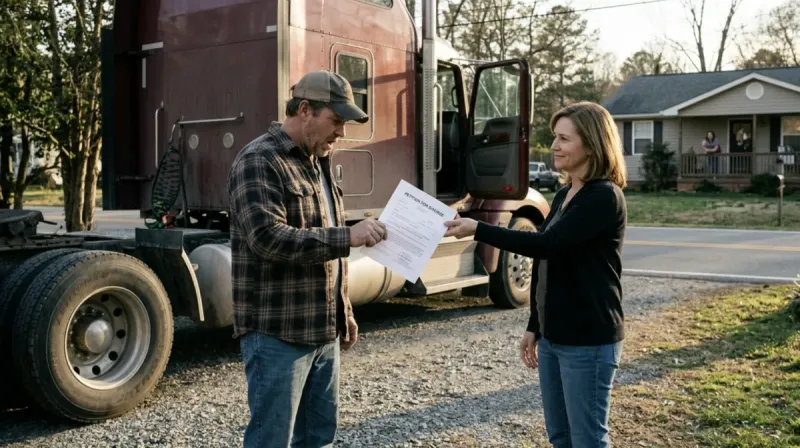
Part of it went toward the nephew’s struggling trucking business.
Part went to Brenda.
Part paid for Alden’s mower and other personal expenses.
The money had been spent.
But the debt remained.
The authorities investigated the suspected forgery, and the lender began reviewing its own procedures.
It was a long, exhausting process.
There were interviews.
More documents.
More phone calls.
And more than once, I wanted to give up.
But Rebecca kept reminding me that every document mattered.
Eventually, the lender agreed that the disputed signature could not be relied upon to establish my consent.
After further review and legal negotiations, the unauthorized claim against my property was released.
The lender continued pursuing the people responsible for the debt, but my forty acres were no longer tied to that loan.
When Rebecca called to tell me, I was standing in the kitchen.
I had just finished making biscuits.
“Joanne,” she said, “the release has been recorded.”
I sat down.
“You’re sure?”
“Yes.
Your property is no longer subject to that disputed lien.”
I covered my mouth.
For several seconds, I couldn’t speak.
Then I started crying.
Not the kind of crying I had done in the courthouse parking lot.
This time, they were tears of relief.
My daddy’s farm was safe.
The old farmhouse was safe.
The forty acres were still mine.
I looked toward the window.
The pasture was full of goats.
And I whispered:
“Daddy, I kept it.”
Alden’s life began changing in ways he hadn’t expected.
Brenda stopped calling him every morning.
His sisters weren’t as interested in inviting him to family dinners.
His nephew’s trucking business eventually closed, and the money Alden had borrowed was not coming back.
The zero-turn mower sat in the garage more often than it ran.
One evening, Alden came into the kitchen and found me looking through an old photo album.
He sat across from me.
“What’s that?”
“Our wedding pictures.”
He leaned forward.
There we were.
Two young people standing outside a little church in 1981.
I wore a simple white dress.
Alden had a brown suit and a smile that made him look ten years younger.
He touched the photograph.
“Look at us.”
I nodded.
“We were happy.”
He swallowed.
“I miss those days.”
I closed the album.
“So do I.”
He stared at the table.
“Do you think we can start over?”
I looked at him.
That was a question I’d imagined hearing for years.
But when it finally came, I didn’t feel excited.
I didn’t feel hopeful.
I felt tired.
“Alden, starting over requires two people admitting what happened.”
“I’ve admitted it.”
“No. You’ve admitted you made mistakes. You still haven’t admitted what those mistakes cost me.”
He looked down.
I continued.
“You took control of my money. You treated my work like it didn’t matter. You used my property without asking. You let your family believe they had a right to something that belonged to me.”
He rubbed his eyes.
“I know.”
“And when I finally stood up for myself, you told me I was destroying the family.”
He didn’t speak.
I reached across the table and closed the photo album.
“I don’t hate you, Alden.”
He looked up.
“But I don’t want to live like that anymore.”
His eyes filled with tears.
“You’re really leaving me?”
I took a breath.
“I think we’ve been living apart for a long time. We just happened to sleep under the same roof.”
Three months later, I filed for divorce.
Rebecca helped me through the process.
Because the farmhouse and forty acres were my separate inherited property, they were treated accordingly under the applicable law.
The disputed debt and other financial issues were addressed separately.
I didn’t ask for Alden’s trucking income.
I didn’t ask for his truck.
I didn’t ask for his retirement money.
I asked for a fair resolution and the return of anything that belonged to me.
Alden wasn’t happy.
His sisters called me cruel.
Brenda left two angry messages on my answering machine.
Linda sent me a text saying I had ruined everybody’s lives.
I deleted them.
I had spent too many years carrying other people’s problems.
I wasn’t going to carry their anger, too.
One afternoon, Alden came to collect the rest of his belongings.
He stood in the bedroom doorway holding an old photograph.
It was the two of us at a lake, probably twenty years earlier.
“You want this?”
I looked at it.
“Keep it if you want.”
He nodded.
Then he looked around the room.
“Where am I supposed to go?”
I felt a little sadness.
We had been together for almost half a century.
But I couldn’t let guilt become another chain around my neck.
“You’ll figure it out, Alden.”
He looked at me.
“I never thought you’d do this.”
I smiled sadly.
“Neither did I.”
He carried his things to the truck.
Before he left, he stopped at the kitchen door.
“Joanne?”
“Yes?”
“I’m sorry.”
I looked at him.
For once, he wasn’t shouting.
He wasn’t demanding.
He wasn’t telling me what to do.
He simply looked like an old man who had finally realized that some things cannot be bought back.
“I believe you’re sorry, Alden,” I said.
He nodded.
Then he drove away.
I watched his truck disappear down the gravel road.
And when it was gone, I locked the door
Not because I was afraid he’d return.
Because I finally understood that I was allowed to decide who came inside.
The following spring, the Yoders renewed their pasture lease.
Miriam and her husband paid me on the first of every month.
No reminders.
No arguments.
No asking Alden.
I used some of that money to replace the water heater.
The repairman came on a Tuesday morning.
By lunchtime, I had hot water again.
I stood in the bathroom and turned the faucet.
Hot water poured out.
I started laughing.
Then, unexpectedly, I cried.
Six weeks of heating water on the stove had once seemed like a small sacrifice.
But standing there, I realized it had never been about the water heater.
It was about being made to feel that my needs were unimportant.
That afternoon, I bought myself a new winter coat.
A beautiful navy-blue one with a warm lining.
I didn’t ask anybody.
I didn’t explain why I needed it.
I simply bought it.
And I wore it home.
By the end of the year, the pasture had become something special.
Miriam’s goats were healthy.
The grass was thick.
The old fence had been repaired.
And the Yoders started selling goat cheese and milk at the Saturday farmers’ market.
They even put up a little wooden sign near the road:
KITTLE FARM PASTURE
I hadn’t asked them to do that.
When I saw it, I smiled.
One Saturday, Miriam invited me to the market.
I stood behind her table, selling jars of homemade preserves and answering questions from people who wanted to know about the farmhouse.
A young woman buying goat cheese looked at me.
“Are you the owner?”
I smiled.
“I am.”
“That’s a beautiful place.”
I looked across the road.
The farmhouse stood beneath the big oak tree.
The porch needed painting.
The barn needed repairs.
But it was still standing.
“Thank you,” I said. “My daddy left it to me.”
The young woman smiled.
“Then he must have loved you very much.”
I looked at the house.
“He did.”
And I realized I had spent so many years letting someone else tell me what that inheritance meant.
It wasn’t just land.
It was a promise.
A promise that I would always have somewhere to stand.
A year after Alden left, I received a letter.
It came in a plain white envelope.
There was no return address.
But I recognized his handwriting.
I sat at the kitchen table and opened it.
It was three pages long.
He wrote about his trucking routes.
About how quiet his apartment was.
About how he missed coming home to the smell of coffee.
He wrote that Brenda had stopped speaking to him for a while.
He wrote that he had started attending church again.
And near the bottom, he wrote:
I know I can’t ask you to come back. I just wish I had understood what I had before I lost it. You were always there, Joanne. I thought that meant you always would be.
I read that sentence twice.
Then I folded the letter and placed it in the drawer.
I didn’t hate him.
I didn’t wish him harm.
But I wasn’t going back.
Sometimes forgiveness means letting go of the anger.
It doesn’t mean giving someone another chance to hurt you.
That summer, Miriam and I sat on my porch watching the goats settle down for the evening.
She had brought sweet tea.
I had made peach cobbler.
The sun was going down behind the trees.
Miriam looked at me.
“You ever regret it?”
I knew exactly what she meant.
“The divorce?”
She nodded.
I thought for a moment.
“I regret the years I spent believing I didn’t have a choice.”
She smiled.
“That’s a good answer.”
I looked across the pasture.
A little brown goat was trying to climb onto an old tree stump.
It slipped, tried again, and finally made it.
Miriam laughed.
“Stubborn little thing.”
I smiled.
“Reminds me of somebody.”
She nudged my shoulder.
We sat quietly for a while.
Then I told her something I’d been thinking about.
“I’m going to put a garden behind the barn.”
“What are you planting?”
“Tomatoes, green beans, cucumbers. Maybe some flowers.”
“That’s a lot of work.”
“I know.”
“Who’s going to help you?”
I looked at her.
“Me.”
She burst out laughing.
And I laughed with her.
On the forty-fifth anniversary of my father’s death, I drove into town and visited his grave.
I took a small bouquet of yellow flowers.
I cleaned the headstone and sat beside it for a while.
“Daddy,” I whispered, “I almost lost it.”
The wind moved through the trees.
“I almost let somebody convince me that what you left me didn’t matter.”
I brushed a little dirt from the edge of the stone.
“But I kept the house.”
I smiled.
“I fixed the water heater, too.”
Then I laughed.
Because somehow, that seemed like the sort of thing he’d have wanted to hear.
Before I left, I placed the flowers beside his name.
And I said something I wish I’d understood forty-five years earlier.
“I don’t need anyone’s permission to belong to myself.”
A few months later, I was sitting on the porch when I heard a familiar engine.
Alden’s truck.
He pulled into the driveway and stepped out.
He looked older.
His hair was thinner, and he walked more slowly than I remembered.
I stood up.
“Hello, Alden.”
“Hello, Joanne.”
He looked toward the pasture.
The goats were grazing in the late afternoon sunlight.
“Looks good.”
“Thank you.”
He nodded.
“I heard the Yoders are doing well.”
“They are.”
He stood there for a moment.
Then he said:
“I guess you were right about the land.”
I smiled.
“About which part?”
“That it was yours.”
I looked at him.
“It always was.”
He nodded.
Then he looked at the farmhouse.
“Take care of yourself, Joanne.”
“You, too, Alden.”
He climbed back into his truck.
This time, there was no argument.
No demand.
No paycheck waved in my face.
He simply drove away.
I watched until the dust settled.
Then I went inside and made myself a cup of coffee.
Today, I’m seventy years old.
I still live in the farmhouse my daddy left me.
The front pasture is green, the goats are healthy, and the old oak tree is still standing.
I have a new water heater.
A new coat.
A little savings account with my name on it.
And a kitchen table where nobody has to ask permission to speak.
Miriam comes over every Thursday.
We drink coffee, trade vegetables, and laugh about things that probably wouldn’t be funny to anybody else.
Sometimes I still think about those forty-five years.
I think about the woman who heated bathwater on a stove because her husband said they couldn’t afford a water heater.
I think about the woman who apologized for buying groceries.
I think about the woman who cried in a courthouse parking lot because she was afraid that standing up for herself might make her a bad wife.
And I wish I could go back and tell her something.
I’d tell her that being a good wife doesn’t mean being an invisible one.
I’d tell her that love doesn’t require surrendering your identity.
I’d tell her that a marriage should be a partnership, not a paycheck with a set of instructions attached.
But most of all, I’d tell her this:
You are allowed to protect what belongs to you.
And if someone tells you that you have no right to make decisions because they earn more money, remember that your worth was never measured by the number on their paycheck.
Alden once stood in my kitchen and waved his check in my face.
“Whoever brings this home calls the shots, Joanne.”
I remember smiling at him.
I remember telling him I’d have something special waiting.
And I did.
Not chicken and dumplings.
Not an apology.
Not another promise to be quiet.
I gave him the truth.
A deed.
A lease agreement.
And the beginning of a life that belonged to me again.
The best thing I ever brought home wasn’t a paycheck.
It was my freedom.
And I never had to ask anybody for permission to keep it.

One Comment on “PART 5 – “My Husband Forged My Signature to Steal $186,400 Against My Farm—He Never Expected Me to Fight Back and Take Back Control of My Life””