PART 3
My father suddenly stopped looking at the judge.
Ava’s smile disappeared.
The video continued.
My mother tapped the document with one finger.
“You need to understand, Ava, this is the only way. She won’t willingly leave.”
Ava crossed her arms.
“What if she refuses to sign?”
My mother laughed.
Not nervously.
Not uncertainly.
She laughed like someone who had already won.
“She won’t have a choice.”
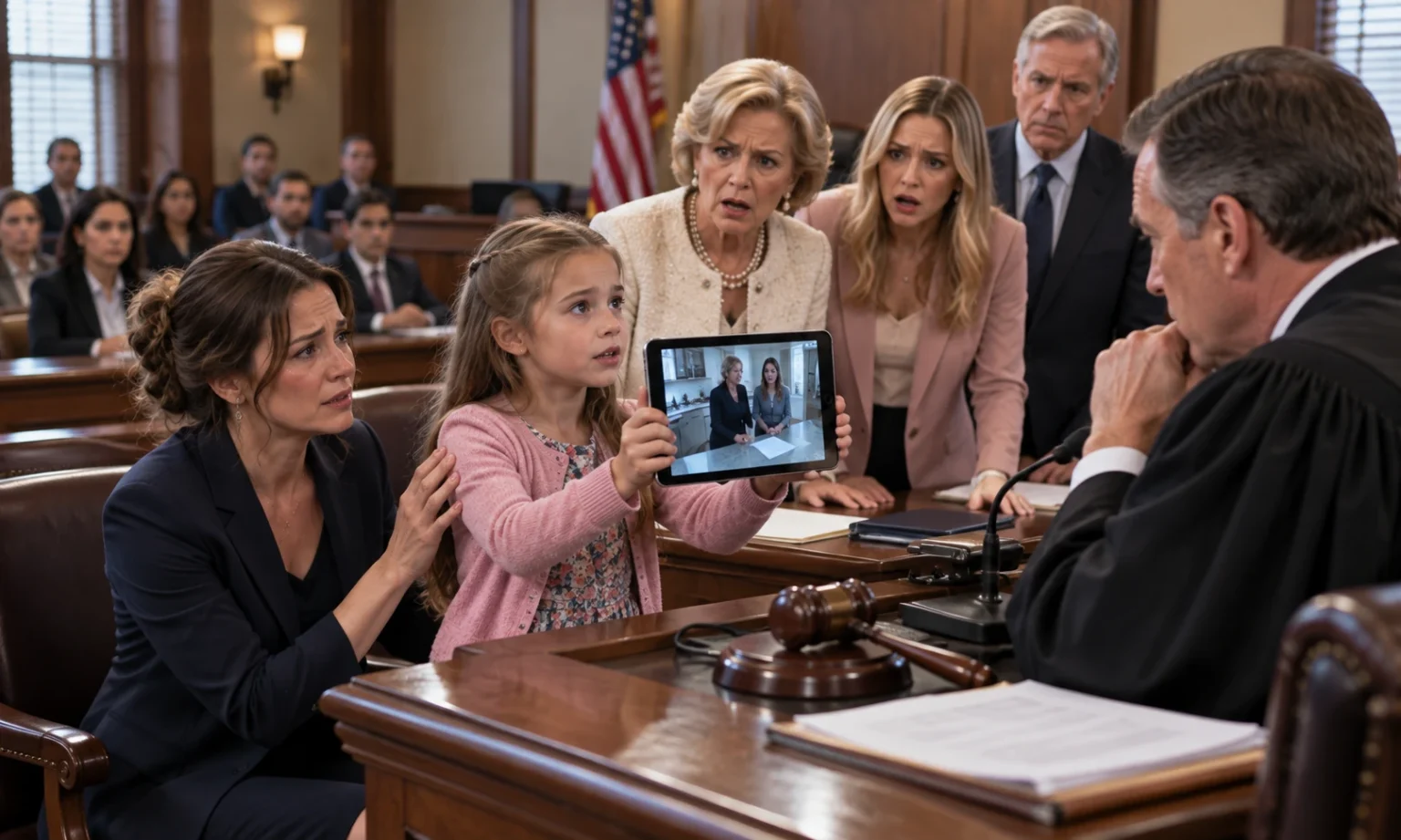
I stared at the screen.
My hands began trembling.
I had never seen this recording before.
Norah had never shown it to me.
I didn’t even know our living-room camera had recorded audio.
The judge leaned forward.
“Can you pause the video?”
Norah immediately stopped it.
The judge looked at her.
“Where did you get this recording?”
Norah swallowed.
“From our camera.”
“Who gave you permission to access it?”
Norah looked at me.
“I did.”
The judge raised an eyebrow.
“You did?”
Norah nodded.
“I know how to open the camera app because Mommy taught me when I was sick. Sometimes she lets me check if the front door is locked.”
My heart tightened.
I had taught my daughter how to use the camera because during her illness, I sometimes had to step outside to speak with doctors or pharmacy staff.
I never imagined she would someday use that knowledge to protect me.
The judge turned toward my parents.
“Is this your home?”
My mother answered immediately.
“Yes, Your Honor.”
“Is the carriage house on your property?”
“Yes.”
“Did you enter the carriage house without the defendant’s permission?”
My mother hesitated.
“We have always had access to it.”
“That wasn’t my question.”
Silence.
My father finally spoke.
“She is our daughter. We were checking on the property.”
The judge’s expression didn’t change.
“And the lease agreement?”
My father looked at my mother.
My mother looked at Ava.
Nobody answered.
The judge asked again.
“Who prepared that document?”
My mother slowly said, “Our attorney.”
“Did the defendant sign it?”
“No.”
“Then what exactly was the purpose of bringing it into her home?”
My mother’s lips tightened.
“It was an offer.”
The judge nodded slowly.
“An offer?”
“Yes.”
I almost laughed.
An offer.
That was what they called it.
After years of me paying their bills.
After I had helped Ava through college.
After I had paid for repairs on my parents’ roof.
After I had covered property taxes when my father was out of work.
After I had spent thousands rebuilding the carriage house where my sick daughter had finally found a quiet place to recover.
They had decided that the best way to describe taking my home was an offer.
The judge looked back at Norah.
“Is there anything else on the recording?”
Norah hesitated.
Then she nodded.
“There is another part.”
My stomach dropped.
“Norah,” I whispered.
She looked at me.
“I think the judge needs to see it.”
She pressed play.
The recording continued.
My mother picked up the lease.
Ava walked toward the window.
Then my mother said something that made my entire body go cold.
“If she fights us in court, we’ll say she was only allowed to stay there temporarily because of Norah’s illness.”
Ava turned.
“But she has receipts.”
My mother shrugged.
“Receipts don’t prove ownership.”
Ava frowned.
“What about all the money she spent?”
My mother laughed again.
“That was her choice.”
The courtroom was silent.
My eyes burned.
Not because I was surprised.
Because I wasn’t.
Somewhere deep inside, I had always known they thought that way.
I had simply spent years pretending they didn’t.
The video continued.
Ava moved closer.
“And what if the judge asks why you want me to have the house?”
My mother answered without hesitation.
“Because you’re the one who deserves a fresh start.”
Ava smiled.
“And her?”
My mother paused.
Then she said:
“She has always known how to survive.”
The recording stopped.
Norah lowered the tablet.
I couldn’t move.
For several seconds, nobody spoke.
Then the judge looked directly at my mother.
“Is that your voice?”
My mother opened her mouth.
Nothing came out.
The judge repeated the question.
“Is that your voice?”
“Yes.”
It was barely audible.
The judge nodded.
Then he looked at Ava.
“Is that your voice in the recording?”
Ava’s eyes filled with tears.
“Yes.”
The judge leaned back.
“Thank you.”
He turned to the court clerk.
“Mark the recording as an exhibit.”
My attorney immediately stood.
“Your Honor, we also have the renovation receipts, contractor invoices, bank statements, property communications, and photographs showing the condition of the carriage house before my client repaired it.”
The judge nodded.
“Bring them forward.”
My attorney handed over a thick binder.
The judge opened it.
Page after page.
Every payment.
Every repair.
Every contractor.
Every receipt.
The broken windows.
The damaged flooring.
The plumbing repairs.
The roof.
The electrical work.
The heating system.
Even the new bedroom Norah needed because her old room had mold damage.
The judge studied everything.
My father suddenly spoke.
“Your Honor, we never told her she could claim the property.”
My attorney turned toward him.
“She isn’t claiming the land. She is asking the court to recognize her lawful occupancy and prevent an unlawful eviction.”
My father looked angry.
“This is a family matter.”
The judge looked over his glasses.
“No, sir.”
Everyone became silent.
“This is a legal matter.”
My father sat down.
Then something unexpected happened.
Ava began crying.
Real tears.
But this time, I didn’t feel sorry for her.
She stood.
“I didn’t know.”
My mother looked at her sharply.
“Sit down.”
Ava ignored her.
“I didn’t know she paid for all of it.”
My attorney slowly turned toward her.
Ava wiped her face.
“Mom told me the house was basically empty. She told me my sister had been given a place temporarily. She said the repairs were mostly paid for by Dad.”
My father stared at her.
“Ava—”
“No.”
Ava shook her head.
“You told me she was trying to keep the property away from me.”
My mother stood.
“Enough.”
But Ava continued.
“You said she was selfish.”
My mother’s face changed.
“You said she had plenty of money because she worked from home.”
I looked at Ava.
She looked back at me.
And for the first time in years, my sister looked less like the enemy and more like someone who had finally realized she had been used.
“I believed you,” Ava whispered.
My mother snapped.
“You should!”
Ava flinched.
The courtroom went silent again.
Then Ava said something I never expected.
“I want to withdraw the eviction request.”
My father stood.
“What?”
Ava turned toward him.
“I said I want to withdraw it.”
My mother’s face became pale.
“You can’t.”
“Why not?”
“Because we’ve already filed.”
Ava shook her head.
“No, Mom. You filed.”
My father looked at her.
“We did this for you.”
“No,” Ava said quietly.
“You did this because you wanted me to have what she had.”
Her eyes moved toward me.
“But I don’t want it anymore.”
I couldn’t speak.
Ava looked down at the floor.
“I thought she was getting something handed to her.”
She swallowed.
“I didn’t know she rebuilt it.”
My daughter Norah suddenly reached for my hand.
I squeezed it.
The judge watched all of us for several seconds.
Then he said:
“Ms. Ava, withdrawing your support for the petition does not automatically resolve the case. Your parents are still plaintiffs.”
Ava nodded.
“I understand.”
The judge turned toward my parents.
“Do you wish to continue?”
My father opened his mouth.
My mother answered first.
“Yes.”
Ava turned toward her.
“Mom…”
My mother didn’t look at her.
“We’re continuing.”
My heart sank.
I had hoped the recording would be enough.
But now I understood.
My parents weren’t fighting for the house anymore.
They were fighting because they couldn’t bear to lose control.
My attorney leaned toward me.
“Don’t worry.”
I whispered, “What else do we have?”
He looked at the binder.
“More than they know.”
I stared at him.
“What does that mean?”
He smiled slightly.
“There’s a reason I asked you to bring every financial record you had.”
He opened a second folder.
And when I saw what was inside, I realized something terrifying.
The carriage house wasn’t the only thing my parents had lied about.
There were three more properties.
And my name appeared on all three.
But I had never signed anything giving them permission to use my money to purchase them.
My attorney whispered:
“They’ve been telling the court you’re financially dependent on them.”
He placed a document in front of me.
“But the bank records tell a very different story.”
I stared at the numbers.
My parents had spent years telling everyone I owed them.
But according to the records…
they owed me.
And suddenly, I understood why they were so desperate to get me out of that little house.
They weren’t trying to give Ava a home.
They were trying to remove the one person who could finally expose everything.
My attorney closed the folder.
“There’s one more thing.”
I looked at him.
“What?”
He glanced toward my parents.
Then toward the judge.
“They don’t know we found the original agreement.”
My heart stopped.
“Original agreement?”
He nodded.
“The one that proves exactly who paid for the carriage house.”
He placed one final document on the table.
And at the bottom of the page was my father’s signature.
But that wasn’t what shocked me.
It was the handwritten sentence beneath it.
A sentence my father had written himself.
A sentence that could completely destroy their case.
“The carriage house belongs to my daughter for as long as she and Norah need a home.”
My father’s handwritten sentence sat beneath his signature like a confession he had forgotten to destroy.
“The carriage house belongs to my daughter for as long as she and Norah need a home.”