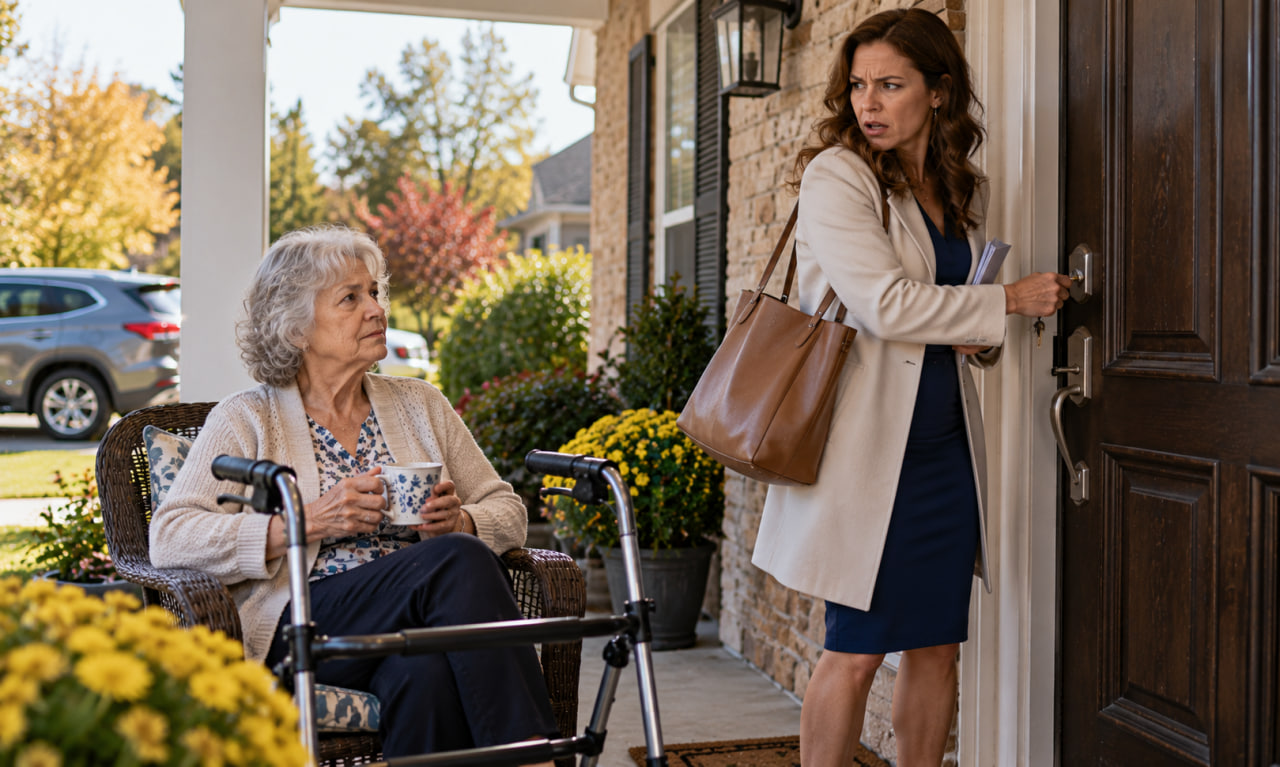
PART 5
“Inside?”
“No.”
He stared.
“You changed the locks.”
“Yes.”
“Why?”
“Because I own the house.”
He nodded slowly.
“I know.”
That surprised me.
“You know?”
“Yes.”
“Then why did you let her try to sell it?”
He looked at Bridget.
She whispered, “Curtis…”
He raised his hand.
“Let me answer.”
He looked at me.
“I was desperate.”
“I know.”
“I made some bad decisions.”
“I know.”
“I thought I could fix everything.”
“With my house.”
He looked down.
“Yes.”
I waited.
He sat on the porch step.
“I lost money.”
“How much?”
“Three hundred and twelve thousand.”
Bridget looked at him.
“You said two hundred eighty.”
“I didn’t tell you everything.”
She stared.
I almost felt sorry for her.
Almost.
“Where did the money go?”
“Investments. Loans. The restaurant. Some gambling.”
My heart sank.
“Gambling?”
He nodded.
“How long?”
“Two years.”
“And you never told me.”
“I was ashamed.”
“You weren’t ashamed enough to sell my house.”
He covered his face.
“I didn’t know what else to do.”
“You could have asked me.”
“I knew you would say no.”
“Yes.”
He looked up.
“That’s why.”
“What?”
“You always taught me to stand on my own.”
I shook my head.
“That wasn’t a lesson in how to hide from consequences.”
He cried then.
My son.
The little boy who once climbed into my bed during thunderstorms.
The man sitting in front of me looked nothing like that boy.
But I still saw him.
I loved him.
That was the hardest part.
Love does not disappear just because someone disappoints you.
But love also doesn’t require you to surrender everything.
I looked at him.
“You made a terrible mistake.”
“I know.”
“You involved your wife.”
“I know.”
“You planned to sell my house.”
“I know.”
“You planned to put me somewhere else.”
His voice cracked.
“I know.”
“And you let her tell people she was taking care of me.”
He looked at Bridget.
“I didn’t know she was saying that.”
Bridget turned sharply.
“You knew.”
“I knew she helped.”
“You knew about Fairview.”
He went silent.
That silence was an answer.
I closed my eyes.
“Curtis.”
“Mom…”
“Why?”
He started crying.
“Because I was scared.”
I nodded.
“So was I.”
He looked at me.
“But I didn’t steal from you.”
He lowered his head.
That was the end of the argument.
Mr. Bennett arrived an hour later.
He was older than I remembered.
But his eyes were sharp.
He carried a leather briefcase and walked up the porch.
“Eleanor.”
“Hello, Richard.”
He smiled.
“I was wondering when you’d finally call me.”
I looked at Rosalind.
She shrugged.
“Your husband called me six months before he died.”
I froze.
“What?”
Richard opened his briefcase.
“He asked me to prepare some protections.”
“For me?”
“For you.”
He pulled out a document.
“Walter created a living trust.”
I stared.
“A trust?”
“Yes.”
“Why didn’t I know?”
“Because he wanted to explain it to you himself.”
“He never did.”
Richard’s expression softened.
“He became ill before he could.”
I looked at the document.
“What does it say?”
He explained everything.
The house belonged to the trust.
I was the sole lifetime beneficiary.
Nobody could sell it without my authorization.
Curtis could inherit after my death, but he had no authority to sell, mortgage, or transfer it while I was alive.
And there was something else.
A clause Walter had added.
If anyone attempted to use fraud, coercion, or deception to transfer the property, their future inheritance could be reduced or eliminated.
I stared at him.
“Walter did that?”
“Yes.”
“Why?”
Richard looked at me.
“Because he knew you loved your son.”
I felt tears come.
“And he knew that love might make you vulnerable.”
I laughed softly.
“That sounds like Walter.”
Richard nodded.
“There is one more thing.”
“What?”
He pulled out another document.
“The attempted sale is already documented.”
My stomach tightened.
“What happens now?”
“That depends on what you want.”
I looked at Curtis.
He was sitting with his hands clasped.
“What can I do?”
Richard answered carefully.
“You can pursue legal action.”
Bridget immediately stood.
“No.”
Richard looked at her.
“You should probably sit down.”
She sat.
I looked at Curtis.
“Did you sign anything?”
He hesitated.
“Yes.”
“What?”
“A loan agreement.”
“With the house as collateral?”
“Yes.”
Richard’s face hardened.
“Where?”
“A private lender.”
“How much?”
“Two hundred thousand.”
Richard sighed.
“That’s serious.”
I looked at my son.
“Did you give them a copy of the deed?”
“Yes.”
“Did they know you weren’t the owner?”
“No.”
Richard looked at me.
“That explains the buyer.”
My stomach dropped.
“What buyer?”
“The lender.”
Curtis looked at him.
“What?”
Richard opened the folder.
“The person who thought he was purchasing this house may not have been an ordinary buyer.”
I stared.
“Then who was he?”
Richard looked at Curtis.
“Your lender.”
Silence.
Curtis looked terrified.
“He told me if I didn’t repay the loan, he would take the property.”
“He couldn’t legally take it.”
“I didn’t know.”
“No,” Richard said. “But he could make your life extremely difficult.”
I looked at Bridget.
“And you?”
She looked down.
“I signed the listing because Curtis asked me.”
“Did you know the lender was the buyer?”
She didn’t answer.
“Bridget.”
She whispered:
“Yes.”
My chest tightened.
“So you knew.”
“Yes.”
“And you still did it.”
“I thought if we sold the house, we could pay him back.”
“And leave me with nothing.”
“I thought Fairview would be temporary.”
I stared at her.
“Temporary?”
She nodded.
“You were going to take me out of my home, sell everything, and tell yourself it was temporary.”
She cried.
“I was trying to save my marriage.”
I answered quietly.
“You were trying to save yourself.”
She looked away.
Perhaps that was the first honest thing either of us had heard that morning.
The police were not called that day.
Richard advised me not to make decisions while emotional.
So I didn’t.
Instead, I made one decision.
Bridget was leaving.
Not tomorrow.
Not next week.
That day.
She packed her belongings into two suitcases.
When she walked past the porch, she stopped.
“Eleanor.”
I looked at her.
“I am sorry.”
I believed that she was sorry.
But being sorry didn’t undo four years.
“Goodbye, Bridget.”
She nodded.
Then she walked away.
Curtis stayed.
He sat beside me until sunset.
We didn’t speak much.
At one point he said:
“Do you hate me?”
I looked at him.
“No.”
He began crying.
“But I don’t trust you.”
He nodded.
“I understand.”
“Trust is not something you ask for after breaking it.”
“I know.”
“You earn it.”
“I know.”
“And it may take years.”
He nodded again.
“I’ll wait.”
I looked at him.
“Good.”
Three months passed.
The attempted sale was canceled.
The lender’s claim against the house was challenged.
The listing agreement was terminated.
The documents Bridget had taken were returned.
And the silver chest went back into my dining room.
Exactly where Walter had left it.
Curtis sold his car.
Closed his restaurant investment.
Entered a repayment agreement.
And, for the first time in years, he learned what living within his means actually meant.
He did not move back into my house.
That was my condition.
He rented a small apartment.
He found steady work.
He started paying his debts himself.
And every Sunday, he came for lunch.
Not because he expected anything.
Because he wanted to rebuild something.
Sometimes we talked.
Sometimes we argued.
Sometimes we sat quietly.
But slowly, carefully, our relationship began to heal.
Bridget and Curtis eventually separated.
I never asked whether they would divorce.
That was their business.
I had enough business of my own.
Six months after the day I changed the locks, I sat on my porch with my coffee.
The same porch.
The same chair.
The same maple tree.
But I was different.
My eyesight was still poor.
My walker still stood beside me.
I still needed Rosalind to read some of my mail.
But I had learned something important.
Needing help was not the same as surrendering control.
Growing old was not the same as becoming invisible.
And trusting someone did not mean refusing to question them.
Rosalind came up the steps carrying two coffees.
She handed me one.
“You look peaceful.”
“I am.”
“You ever regret changing those locks?”
I looked at the front door.
“No.”
She smiled.
“Good.”
I laughed.
“You know what the funniest part is?”
“What?”
“I thought the locks were going to keep people out.”
Rosalind nodded.
“And?”
“They actually reminded me that I was allowed to decide who came in.”
She sat beside me.
We drank our coffee.
After a while, a car pulled into the driveway.
Curtis got out.
He carried a paper bag.
“Lunch,” he called.
I smiled.
“Come on up.”
He walked toward the porch.
Before he reached the steps, he stopped.
“Mom?”
“Yes?”
“Can I ask you something?”
“What?”
“Would you ever let me have a key again?”
I looked at him.
He looked nervous.
I smiled.
“Eventually.”
He laughed.
“That sounds fair.”
“It is.”
He came up the steps.
We ate lunch together.
Nothing dramatic happened.
No shouting.
No lawyers.
No police.
No secret folders.
Just a mother and her son sitting at a table.
And somehow, that felt like the biggest victory of all.
A year later, I planted roses beside Walter’s old workshop.
The house looked almost exactly as it had when we moved in.
Except for one thing.
The front door had a new lock.
Not because I was afraid.
Because every time I turned the key, I remembered the morning I finally understood something Walter had known all along.
A house is not valuable because of its walls.
It is valuable because of the life lived inside it.
And no one gets to decide when that life is over simply because they think an old woman is too tired to fight.
I was tired.
I was seventy-eight years old.
My eyes were failing.
My knees hurt.
My hands weren’t as steady as they used to be.
But I was still Eleanor.
Walter’s wife.
Curtis’s mother.
Rosalind’s best friend.
And the woman who had built a life inside that house for more than fifty years.
That morning, I thought changing the locks would be the beginning of a war.
Instead, it became the beginning of my freedom.
And every Sunday after that, when Curtis came to lunch, he would knock on the door.
He never used a key.
He never assumed.
He always waited.
And every time I opened the door, I would smile and say the same thing.
“Come in, son.”
Because forgiveness, I learned, doesn’t mean forgetting.
It means remembering exactly what happened…
and choosing not to let it destroy what can still be saved.
The house remained mine.
The silver chest remained in the dining room.
Walter’s letter remained in my bedside drawer.
And the locks?
I never changed them again.
I didn’t need to.
Because now everyone who entered my home understood something very simple:
The door belonged to me.
And so did the life behind it.