PART 5
The administrator’s reply was short.
Mr. Carter, the beneficiary has independent legal rights. We cannot withhold information from her.
Maya looked at me.
“Your grandmother’s administrator appears to have resisted several attempts to keep you uninformed.”
I felt a strange sadness.
My grandmother had tried to protect me even after she was gone.
And I had spent years believing she had left me nothing.
Then Maya opened another attachment.
It was an old bank statement from the separate investment account.
The account balance was much higher than I expected.
Approximately $186,000.
I covered my mouth.
“That’s mine?”
“According to the preliminary records, it was established for your benefit. We still need the complete account documentation, but the account appears to have remained intact.”
My grandmother hadn’t simply left me sixty thousand dollars.
She had created a second opportunity for my future.
And my parents had apparently spent years trying to make sure I never discovered either one.
But the most important moment came that afternoon.
Maya received a call from the investigators handling the identity theft complaints.
They wanted to interview my father.
And Jake.
The news spread through the family quickly.
By evening, Emma called me.
“Olivia, Dad is furious.”
“What happened?”
“He found out the investigators want to speak with him.”
I remained quiet.
Emma continued.
“He’s saying you planned this for months. He’s telling everyone you stole family documents and that Rebecca is manipulating you.”
“Emma, you don’t have to defend me.”
“I know.”
Her voice broke.
“But I need to tell you something.”
I waited.
“Mom admitted something to me.”
“What?”
“She said she knew about the credit accounts from the beginning. She said Dad told her they would pay everything back before you ever found out.”
I closed my eyes.
“Did she say anything else?”
Emma hesitated.
“She said Jake was the one who suggested using your identity because your credit score was better than his.”
I felt sick.
For years, I had helped Jake because he was my brother.
I had believed his business problems were temporary.
I had believed my parents when they said we were simply helping each other.
But the truth was that they had chosen me because they thought I would never fight back.
“Emma,” I said quietly, “why are you telling me this?”
“Because I don’t want to be like them anymore.”
I didn’t forgive her.
Not that day.
But I told her I appreciated the truth.
Two weeks later, the family received another shock.
Jake’s business was placed under financial review after the disputed credit line was escalated. His accountant began cooperating with the investigation and provided records showing where the borrowed money had gone.
Some of it had paid business expenses.
Some had covered personal purchases.
And some had been transferred to my parents.
My mother stopped posting on Facebook.
Jake deleted almost every photograph of his expensive purchases.
The relatives who had celebrated my departure suddenly became much quieter.
Then, on a Tuesday morning, Maya called.
“Olivia, I have an update.”
I sat down.
“The bank has completed an initial review of the disputed refinancing authorization. It has identified serious inconsistencies and referred the matter for further investigation.”
“What happens now?”
“We’ll pursue the appropriate remedies to protect your property interest. The lenders are also continuing their investigations into the accounts opened in your name.”
I breathed slowly.
For the first time, things were moving in the right direction.
But there was still one thing I wanted.
I wanted to see my grandmother’s house again.
Not because I wanted to return to living with my parents.
I didn’t.
I wanted to walk through the rooms without feeling like I owed someone an apology for existing.
Maya arranged a supervised visit with the cooperation of the relevant parties.
When I arrived, my mother was standing near the front door.
She looked exhausted.
The house was exactly as I remembered it.
The same curtains.
The same wooden staircase.
The same family photographs.
Except something was missing.
The photograph of my grandmother had disappeared from the living room.
“Where’s Grandma’s picture?” I asked.
My mother looked away.
“Your father put it away.”
I walked toward the hallway.
I remembered standing there at twenty-one, holding my graduation certificate while my father told me that my salary wasn’t enough to support myself.
I remembered paying the heating bill.
Buying groceries.
Replacing the washing machine.
I remembered Jake laughing when I said I wanted to move out.
And I remembered the photograph he posted when I finally did.
My mother approached me.
“Olivia, please.”
I turned.
Her eyes were wet.
“We didn’t think it would become this serious.”
I looked at her.
“Did you think it was serious when you opened the credit accounts?”
She began crying.
“We were trying to help Jake.”
“With my identity?”
“We thought we could repay everything.”
“And Grandma’s money?”
She didn’t answer.
“Did you think I wouldn’t notice sixty thousand dollars missing?”
My mother lowered her head.
Then she whispered something I will never forget.
“Your father said you would never find out.”
I stared at her.
That sentence hurt more than the Facebook comments.
Because it meant the entire plan had depended on one thing.
My silence.
I left the house without arguing.
Over the following months, the financial investigations continued. The fraudulent accounts were formally disputed, and the lenders began removing the debts from my credit reports as their reviews progressed.
The property dispute was handled through legal proceedings and negotiations. The forged refinancing authorization became a central issue, and the bank pursued its own remedies.
My parents eventually agreed to a financial settlement involving my property interest. The final agreement protected my ownership rights and required compensation for the unauthorized use of my share.
The trust administrator also completed a formal accounting.
The missing inheritance became part of a separate recovery process.
Jake’s business did not survive the financial consequences. He eventually sold its remaining assets and faced legal and financial responsibility for his involvement.
My father and mother also faced formal scrutiny over the documents and transactions.
I didn’t celebrate their troubles.
I simply stopped rescuing them.
Emma postponed her wedding and returned the money connected to the disputed loan. She later apologized again, this time without asking me to forgive her.
It took time before I could trust her.
But eventually, we began rebuilding our relationship slowly.
As for my parents, I established one boundary that never changed:
All communication about financial or legal matters went through my attorney.
No more secret passwords.
No more mysterious bills.
No more family emergencies that somehow became my responsibility.
Six months after leaving, I moved into a small townhouse.
It wasn’t luxurious.
It had two bedrooms, a little balcony and a kitchen where I could finally cook without someone criticizing how much electricity I used.
I placed my grandmother’s photograph on the living room shelf.
Beside it, I framed her letter.
One Saturday morning, I sat on the balcony with a cup of coffee and read her words again.
You are allowed to build something for yourself.
For the first time, I understood what she meant.
I didn’t need to win an argument with 123 relatives.
I didn’t need Jake to apologize publicly.
I didn’t need my father to admit that he had been wrong.
And I didn’t need my mother to explain why she had chosen to protect everyone except me.
I had spent years trying to prove I wasn’t a parasite.
But I finally understood that I had never been one.
I had been a daughter who worked, paid bills, helped her family and trusted the people she loved.
They had mistaken that kindness for permission.
A few months later, I received a notification that Jake had removed the old photograph from his social media history.
I still had my screenshots.
I didn’t delete them.
They reminded me of the day I finally stopped begging for a place in a family that had treated my love like an unlimited bank account.
And on the anniversary of the day I moved out, I posted one photograph.
It was a picture of me standing on the balcony of my new home, holding a cup of coffee.
My caption was simple:
“One year ago, I was called a parasite for leaving a house where I had spent years helping everyone survive. Today, I have my own home, my own future and something nobody can steal from me again: my peace.”
I didn’t tag anyone.
I didn’t mention the money.
I didn’t expose the investigation.
I didn’t need to.
That evening, Aunt Rebecca called.
She told me she had shown the photograph to a few relatives.
“They’re proud of you,” she said.
I smiled.
“Thank you.”
Then she added, “Your grandmother would be proudest of all.”
I looked at her photograph on the shelf.
And for the first time in a very long time, I didn’t cry because I missed the family I thought I had.
I smiled because I had finally built a life where I no longer had to earn the right to belong.
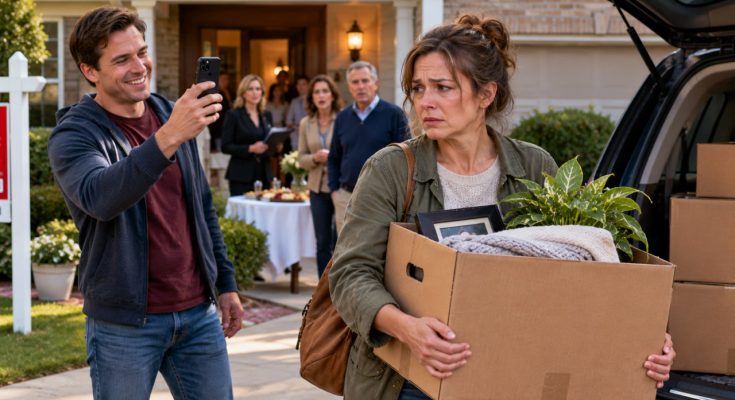
The last box I carried out of my parents’ house wasn’t filled with clothes or books. It was filled with the belief that I owed those people my entire life. And when I finally put it down, I discovered I had been free all along.
The parasite was gone.
But so was the person who had spent years feeding on me.
And I was never going back.



One Comment on “PART 5 – My Brother Called Me a Parasite for Moving Out—Then 123 Relatives Celebrated Before My Parents Started Begging”