PART 5
The trust documents were open.
His name was on the screen.
Trustee.
My father sat down.
Slowly.
Very slowly.
“You weren’t supposed to see that.”
I stared at him.
“No.”
My voice was calm.
“You were supposed to keep it hidden.”
My mother looked at him.
“What is she talking about?”
He didn’t answer.
She turned toward me.
“Evelyn?”
I opened the bank statement.
“Grandma left me $3.8 million.”
My mother’s mouth fell open.
“What?”
My father looked at the floor.
I continued.
“Derek received his trust.”
My mother looked at him.
“You knew?”
She nodded.
“I knew.”
“And Chloe?”
“Yes.”
My mother turned toward my father.
“What about Evelyn?”
He remained silent.
Then my mother understood.
Her eyes filled with tears.
“Richard…”
He finally spoke.
“I was going to put it back.”
“When?”
He looked at her.
“When things improved.”
My mother stared at him.
“How much did you take?”
He didn’t answer.
She asked again.
“How much?”
“About two million.”
I felt my stomach drop.
Derek stepped forward.
“That doesn’t include the interest.”
My father glared at him.
“Stay out of this.”
“No.”
Derek’s voice shook.
“For once, I’m not staying out of it.”
He looked at me.
“I found another document.”
He took out several printed pages.
“Dad transferred part of Evelyn’s trust into the development company as a loan.”
My father stood.
“It was temporary.”
Derek continued.
“There was no repayment schedule.”
My father shouted.
“I said I was going to repay it!”
My mother started crying.
“You stole from your daughter.”
His face twisted.
“I was trying to save this family.”
I looked at him.
“No.”
He turned toward me.
“I was trying to keep the house. Keep your mother’s lifestyle. Keep Derek’s business alive. Keep everything together.”
I shook my head.
“You weren’t saving the family.”
I stood.
“You were saving yourself.”
He didn’t respond.
I picked up the documents.
“I’m getting an attorney.”
My father immediately stepped toward me.
“Evelyn.”
I stopped.
“You wouldn’t do that.”
I looked back.
“Yes.”
“You’ll destroy this family.”
I held his gaze.
“No, Dad.”
My voice was steady.
“You already did.”
The next three months changed everything.
I hired an attorney specializing in trusts and financial fraud.
The investigation was quiet at first.
Then it became enormous.
The accounting records revealed more than anyone expected.
My father hadn’t simply borrowed from my trust.
He had used the money to cover debts, transfer properties, pay company expenses, and hide losses.
Some transfers had been made without proper authorization.
Some documents had been altered.
Some debts had been concealed from my mother.
And the company he claimed was nearly saved had been insolvent for years.
My father’s story collapsed piece by piece.
But there was one thing I didn’t expect.
My mother left him.
Not immediately.
She spent weeks reviewing every document.
Every bank statement.
Every lie.
Then one morning she packed two suitcases.
She came to my apartment.
She stood at the door holding an old photograph of Grandma Eleanor.
“I should have protected you,” she said.
I didn’t know what to say.
She started crying.
“I thought your father was hard because he wanted you to succeed.”
I looked away.
“I know.”
“No.”
She shook her head.
“I didn’t know.”
She handed me the photograph.
“Your grandmother told me something before she died.”
“What?”
“She said, ‘Evelyn will be the one who breaks the pattern.’”
I stared at her.
“What pattern?”
My mother wiped her eyes.
“Everyone in this family had spent generations believing that success meant control.”
She looked at the photograph.
“Your grandmother wanted you to understand that money should give you freedom, not power over someone else.”
I hugged the photograph to my chest.
For the first time in years, I cried in front of my mother.
Not because I was weak.
Because I finally didn’t have to pretend I wasn’t hurt.
My father eventually agreed to repay the trust.
The legal process took time.
Some assets were sold.
Some properties were liquidated.
Some money was recovered.
He lost the company.
He lost the house.
He lost the reputation he had spent decades building.
But he wasn’t destroyed.
And neither was I.
I made sure of that.
I never wanted revenge.
I wanted the truth.
There was a difference.
Derek changed too.
He moved out of the pool house.
He stopped letting Dad rescue him.
He started working.
For the first time in his life, he paid his own bills.
One evening, he called me.
“You know something?”
“What?”
“You were never the failure.”
I smiled.
“I know.”
He laughed softly.
“I spent years thinking Dad was right.”
“So did I.”
“I’m sorry.”
“I know.”
There was silence.
Then he said,
“You still going to Stanford?”
I looked at the acceptance letter sitting on my desk.
“Yes.”
“Good.”
“Why?”
“Because if Dad taught us anything…”
He laughed.
“…it’s that we should never let someone else decide what our future is worth.”
Six months later, I stood inside a laboratory in California.
The walls were covered with research notes.
Computers hummed quietly.
A dozen researchers moved around me.
Dr. Grant walked into the room.
“You ready?”
I smiled.
“Yes.”
She handed me a paper.
“Our preliminary results.”
I looked at the data.
Then at the microscope.
Then at the team.
We had discovered something.
Not a cure.
Not yet.
But a pathway.
A possibility.
A direction.
Something worth pursuing.
I thought about the girl I had once been.
Thirteen years old.
Holding a broken science project.
Standing in a hallway while her family told her she wasn’t good enough.
I wished I could go back and tell that little girl something.
You were never the problem.
You were never too small.
You were never a failure.
You were just surrounded by people who couldn’t recognize what you were becoming.
Two years later, I returned home for the first time.
Not because Dad called.
Not because he needed money.
Not because my family demanded it.
I came because I wanted to.
The old house was gone.
The development company was gone.
My father lived in a modest apartment across town.
When I arrived, he opened the door.
For several seconds, neither of us spoke.
He looked older.
I probably did too.
He glanced at the folder in my hand.
“What’s that?”
I smiled.
“Research results.”
He nodded.
“How’s Stanford?”
“Good.”
“Are you happy?”
The question surprised me.
I looked at him.
“Yes.”
He nodded slowly.
“I heard about the paper.”
“You read it?”
“Your mother sent it.”
I smiled.
“Thank you.”
He looked down.
“I was wrong.”
I didn’t answer.
“I spent years telling you that you weren’t enough.”
His voice trembled.
“And I think…”
He swallowed.
“…I was afraid that if you became successful, you wouldn’t need me anymore.”
I looked at him.
“You were right.”
His eyes filled with tears.
“I know.”
There was no dramatic reconciliation.
No magical forgiveness.
No moment where twenty-two years of pain disappeared.
Real life wasn’t like that.
Instead, I sat across from my father.
We talked.
Slowly.
Honestly.
For the first time.
And when I left that evening, I didn’t feel victorious.
I felt free.
Three years after my graduation, I stood on a stage again.
This time, I wasn’t receiving my degree.
I was receiving an award for young researchers.
The auditorium was packed.
Professors.
Scientists.
Students.
Families.
I walked toward the podium.
Before I began my speech, I looked into the audience.
My mother was there.
Derek was beside her.
And several rows behind them sat my father.
He wasn’t smiling widely.
He wasn’t trying to take credit.
He was simply sitting there.
Listening.
I took a breath.
“When I graduated college,” I began, “someone called me a failure.”
A quiet laugh moved through the room.
“I believed him for a long time.”
I paused.
“Then I learned something important.”
The room became silent.
“Sometimes the people who tell you that you’re not enough aren’t describing you.”
I looked toward my father.
“Sometimes they’re describing their own fear.”
My father lowered his eyes.
I continued.
“I spent years trying to prove that I wasn’t a failure.”
I smiled.
“Eventually, I realized I didn’t need to prove anything.”
The audience listened.
“I only needed to become the person I knew I could be.”
The applause started slowly.
Then it grew.
I looked toward my mother.
She was crying.
Derek was standing.
My father was clapping too.
I looked at him for a moment.
Then I turned back toward the audience.
“Your life doesn’t become valuable because someone finally recognizes your worth.”
I lifted the award.
“Your life becomes yours when you stop letting other people decide what you’re worth.”
The applause filled the auditorium.
And as I stepped away from the podium, I realized something.
My father had called me a failure on the day I graduated.
He had believed he was closing the door on my future.
But he had been wrong.
That day wasn’t the end of my story.
It was the first day I finally understood that my story belonged to me.
The little girl whose science project had been destroyed had grown into a woman who built things no one could take away.
The daughter they underestimated became the researcher they had never imagined.
The girl they tried to keep small crossed an ocean and built a life of her own.
And the money my grandmother had left me?
I eventually used part of it to establish a scholarship.
Not in my father’s name.
Not in mine.
In my grandmother’s.
The scholarship went to students who reminded me of myself.
Students who worked late.
Students who were told their dreams were unrealistic.
Students who couldn’t afford to believe in themselves because everyone around them had already decided they would fail.
Every year, I read their applications.
And every year, I remembered the girl I used to be.
The girl sitting quietly in the back of a graduation auditorium while her father called her a failure.
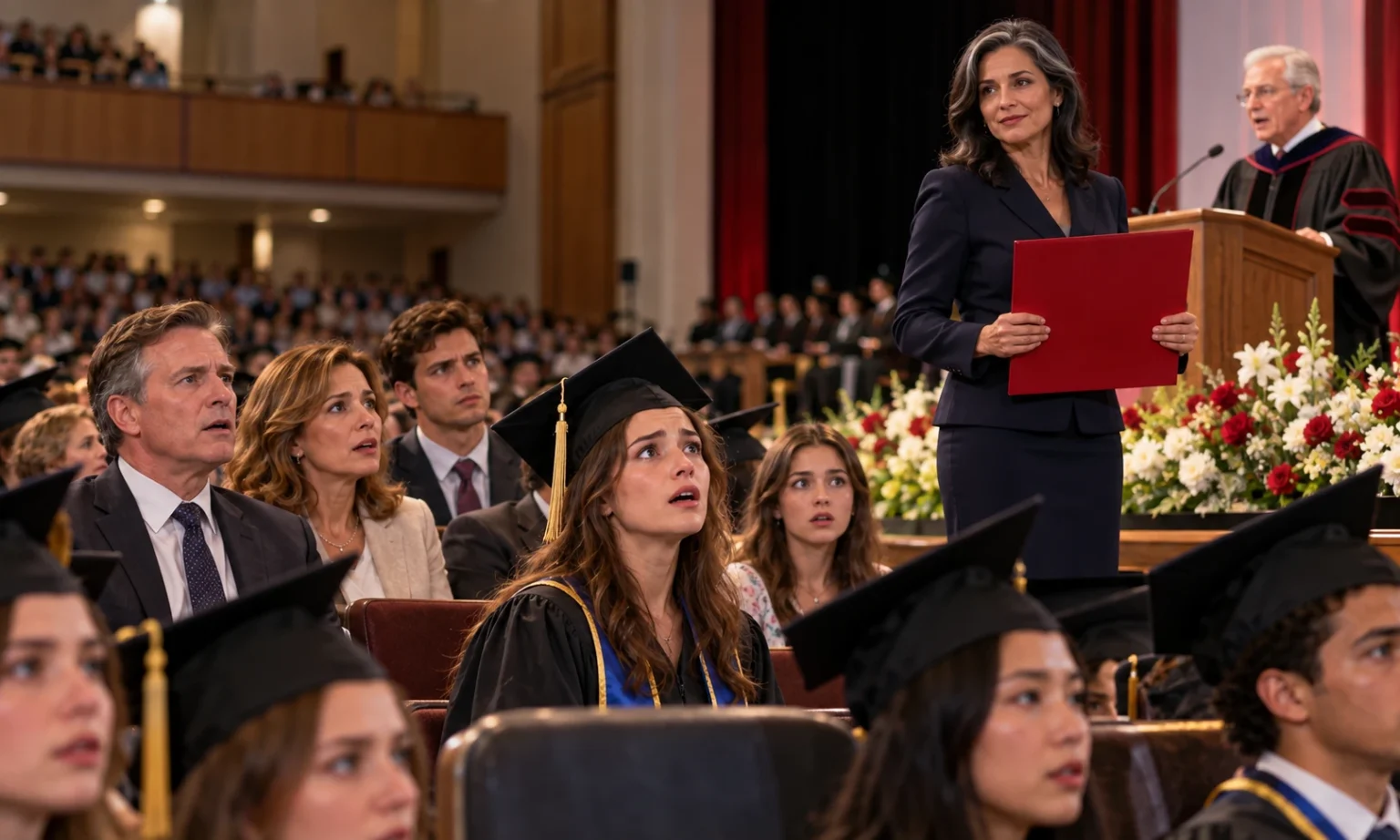
She had no idea that the cardinal-red folder would change her life.
She had no idea that the truth about her family would finally come out.
She had no idea that millions of dollars had been hidden in her name.
She had no idea that one day her research might help people she had never met.
She only knew one thing.
She had worked hard.
And she was tired of being ashamed of it.
So when people ask me what happened on my graduation day, I don’t tell them about the money first.
I don’t tell them about my father’s betrayal.
I don’t tell them about Stanford.
I tell them about the moment Dean Mitchell said my name.
Because that was the moment I finally understood something I should have known all along.
My father had spent twenty-two years trying to convince me that I was a failure.
But he never realized something very important.
A person who is truly a failure doesn’t need someone else to keep reminding them.
He only kept saying it because he was afraid that one day I would stop believing him.
And eventually…
I did.
That was the day my real life began.



One Comment on “PART 5 – My Father Called Me a Failure at Graduation—Then the Dean Called My Name and a Woman From Stanford Stood Up”