PART 3
I stared at the screen.
Almost two weeks.
I looked at the time. It was 8:47 p.m.
My father had refused to help me carry my newborn daughter home from the hospital because he claimed he was having dinner with the very sister who was telling me she hadn’t seen our parents in nearly two weeks.
I felt a strange sensation in my chest—not exactly anger, and not quite sadness.
It was the feeling of discovering that a door you had spent years knocking on had never been locked.
Someone simply hadn’t wanted to open it.
I typed, “Are you sure? Dad said you needed them tonight.”
Sophie replied almost instantly.
“Rachel, I swear. Is something wrong? Why are you at the hospital?”
I hesitated.
Then I sent her a picture.
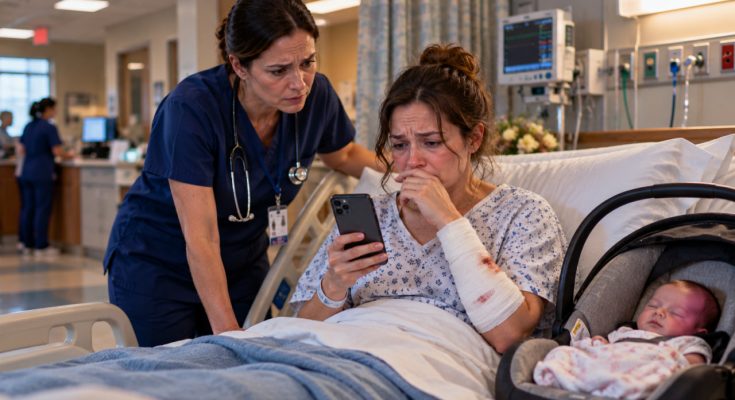
It showed my left arm wrapped in white bandages, the edge of my hospital bracelet, and Ava sleeping beside me in her carrier.
I wrote, “I fell down the stairs and cut my arm. I have seven stitches. The doctor told me not to lift anything heavy, so I called Dad to ask if he could help me get home with Ava until Ethan arrives. He said he couldn’t because you needed them.”
For nearly a minute, there was no response.
Then my phone rang.
Sophie’s name appeared on the screen.
I answered.
“Rachel?”
Her voice sounded different. Smaller somehow.
“Yeah.”
“Are you okay?”
“I’m fine. The cut looks worse than it is.”
“Seven stitches isn’t nothing.”
“I know.”
“Where are you?”
I told her the hospital.
She was quiet for a moment.
Then she asked, “Why didn’t you call me?”
I almost laughed.
Not because it was funny, but because I didn’t know how to explain a relationship that had slowly trained me not to ask for anything.
“You’ve been busy,” I said.
“Rachel, I’m your sister.”
“I know.”
“No, listen to me. I’m serious. Why didn’t you call me?”
I glanced at Ava.
“Because I thought Mom and Dad would help.”
The silence that followed hurt more than I expected.
Then Sophie said, “Stay there. Don’t try to carry anything. I’m coming.”
I sat up a little straighter.
“What?”
“I’m coming to get you.”
“Sophie, you don’t have to.”
“I know I don’t have to. I’m choosing to.”
I heard keys jingling on her end.
“Send me the hospital entrance. I’ll be there in twenty-five minutes.”
“Sophie, you said you haven’t seen Mom and Dad in two weeks. What is going on?”
She stopped moving.
For a moment, I thought she might finally tell me.
Instead, she said, “Let’s get you and Ava home first. We need to talk.”
Then she hung up.
I sat there staring at my phone, feeling as though someone had quietly rearranged the furniture inside my head.
For years, I had believed Sophie was the center of my parents’ attention because she needed more help than I did.
She had always been the one who needed money, advice, emotional support, or another chance.
I had built my adult life around the assumption that I was the stronger daughter.
I had a steady job, a husband who loved me, and now a baby.
Sophie was still figuring things out.
So when my parents canceled plans with me, forgot to return my calls, or spent holidays helping Sophie with another crisis, I told myself it made sense.
I could manage.
She couldn’t.
I had never stopped to ask whether that was actually true.
At 9:14 p.m., Sophie arrived.
She came through the emergency department doors wearing jeans, a gray sweater, and the kind of expression people wear when they’ve been holding back tears for a long time.
She spotted me immediately.
“Rachel.”
I started to stand, but she hurried over.
“Don’t. Just stay there.”
She crouched beside my chair and looked at my bandaged arm.
Then she looked at Ava.
“Oh my God,” she whispered. “She’s so tiny.”
I smiled weakly.
“Four weeks old. That’s what happens.”
Sophie let out a little laugh, but her eyes were already filling.
She reached toward Ava’s blanket, then stopped herself.
“Can I?”
“Of course.”
She gently touched the baby’s hand.
Ava’s fingers curled around hers.
For several seconds, neither of us spoke.
Then Sophie looked at me.
“I’m sorry.”
I frowned.
“For what?”
“For not visiting. For not calling. For letting things get so weird between us.”
I didn’t know what to say.
She swallowed.
“I kept thinking I’d call you when things settled down. Then another week passed, and I felt awkward because I hadn’t called. So I waited longer.”
“That sounds familiar,” I admitted.
She looked at me sadly.
“Doesn’t it?”
The nurse brought my discharge paperwork and explained the instructions again. Sophie listened carefully, asked two questions about lifting restrictions, and took notes on her phone.
When it was time to leave, she insisted on carrying Ava’s diaper bag and infant carrier.
I walked beside her slowly, protecting my injured arm.
Outside, the October air was cool.
Sophie had parked near the entrance.
After she secured Ava in the back seat, she turned toward me.
“Rachel, I need to tell you something.”
I leaned against the car.
“Okay.”
“Mom called me this afternoon.”
I waited.
“She asked if I’d come to dinner tonight. She said she and Dad wanted to talk to me about something important.”
My stomach tightened.
“What did she say?”
“Nothing specific. Just that they had a family matter to discuss and that I shouldn’t worry.”
I looked at her.
“Did you go?”
“No. I told her I was exhausted and wanted to stay home. She sounded disappointed, but she didn’t explain what it was about.”
I thought about Dad’s words.
Your sister needs us tonight.
A family matter.
An important conversation.
Something wasn’t adding up.
“Did you ask what they wanted?”
“I did. Mom said it was better to talk in person.”
Sophie looked down at her hands.
“Rachel, there’s something else.”
I waited.
“About three weeks ago, Mom asked me whether I’d ever consider moving closer to them. She said she and Dad were thinking about making some changes to their finances and living arrangements.”
“What kind of changes?”
“I don’t know. I thought they were talking about retirement.”
She paused.
“Then she asked whether I was still having trouble paying my rent.”
I stared at her.
“Are you?”
Sophie shook her head.
“No. Not anymore. I got promoted in July. I’m doing fine.”
I blinked.
“You got promoted?”
She looked embarrassed.
“Yeah. I tried calling you to tell you, but you didn’t answer. I figured you were busy with the baby.”
I remembered the missed call from an unfamiliar number that I had ignored two weeks earlier.
I hadn’t known it was her.
“I’m sorry,” I said.
“Don’t be. We both got used to not talking.”
She opened the driver’s door.
“Let’s get you home. We can figure out the rest tomorrow.”
I wanted to ask more questions, but I was exhausted, my arm hurt, and Ava needed to be fed.
So I got into the passenger seat.
As Sophie drove us home, I watched the streetlights slide across the window and tried to understand why my father had lied about something so simple.
It wasn’t that he couldn’t help me.
He had made a decision.
And somehow, he had found it easier to invent a reason than to tell me the truth.
I didn’t know what that truth was yet.
But I was beginning to suspect it had very little to do with dinner.
When we reached my apartment, Sophie carried Ava’s things upstairs while I followed slowly.
She helped me settle on the couch, warmed a bottle of water for me, and checked that I had everything within reach.
Then she stood in the middle of my living room, looking around at the baby blankets, the small stack of unopened cards, and the photographs on the mantel.
One picture showed us as children.
I was twelve, Sophie was eight, and Dad had his arms around both of us at a summer fair.
We were laughing.
Sophie stared at it for a long time.
“Do you remember when Dad taught us to ride bikes?” she asked.
“Of course.”
“He ran beside me for three blocks because I was afraid he’d let go.”
I smiled.
“You kept screaming at him not to stop.”
“And you were already riding by yourself.”
I shrugged.
“I liked knowing how things worked.”
Sophie turned toward me.
“You’ve always been the one who figured things out.”
I wasn’t sure whether that was a compliment.
She sat down across from me.
“Rachel, can I ask you something?”
“Sure.”
“Have Mom and Dad ever asked you for money?”
The question caught me off guard.
“Not recently. Why?”
“What about before you got married?”
I thought about it.
There had been small things. A few hundred dollars for a household repair. Money I had lent Dad when his car needed work. A loan to Mom when she said an insurance payment had been delayed.
Nothing that had seemed unreasonable at the time.
“I’ve helped them a few times,” I said. “Why?”
Sophie looked uneasy.
“How much?”
“I don’t know. Maybe a few thousand dollars over the years.”
She nodded slowly.
“Did they pay you back?”
I opened my mouth.
Then closed it.
There had been one transfer from Dad that I assumed was repayment for the car repair. But when I checked my old bank statements a year later, the amount hadn’t matched what I had lent him.
I had never followed up.
“It wasn’t that much,” I said.
Sophie rubbed her forehead.
“Rachel, I think we need to compare notes.”
“About what?”
She looked toward Ava, who had finally fallen asleep in the bassinet beside the couch.
Then she lowered her voice.
“About the money Mom and Dad have been giving me.”
I felt the room grow very still.
“What money?”
Sophie looked as though she regretted bringing it up.
“For the last two years, they’ve been sending me money every month. They told me it was a temporary arrangement because I’d been struggling after my last breakup.”
“How much?”
“Usually around fifteen hundred dollars. Sometimes more if I had a big expense.”
I stared at her.
Fifteen hundred dollars a month.
For two years.
Thirty-six thousand dollars, before the extra payments.
I tried to process it.
“Sophie, I didn’t know.”
“I didn’t know they were refusing to help you tonight, either.”
She looked genuinely distressed.
“They told me they were helping me because I needed a little time to get back on my feet. I never asked them to choose me over you.”