PART 5
I shook my head.
“I thought they meant I wasn’t allowed to need them.”
She looked down at Ava, who was sleeping against her chest.
“Maybe we both believed what they wanted us to believe.”
That sentence stayed with me.
Because the more we talked, the more we realized that our parents had assigned us roles long before either of us was old enough to understand them.
I was the responsible daughter.
Sophie was the struggling daughter.
Whenever I succeeded, my parents treated it as proof that I didn’t need their attention.
Whenever Sophie struggled, they treated it as proof that she needed more of it.
Neither of us had chosen those roles.
Yet both of us had spent years living inside them.
Then, on the sixth day after my accident, Dad called.
“We need to meet,” he said.
“About the financial planning?”
“Yes.”
“Can Sophie come?”
A pause.
“Of course.”
We arranged to meet at our parents’ house that Saturday.
I didn’t know what to expect, but I brought a folder containing the old emails and bank statements showing the money I had lent them over the years.
Sophie brought her own records of the monthly transfers.
Neither of us wanted a fight.
We wanted the truth.
And for the first time, we were prepared to hear it together.
The meeting began quietly.
Mom had made coffee and placed a plate of cookies on the dining table. Dad sat at the head of the table with a thick folder in front of him.
For a moment, it felt like every other family gathering.
Then Dad opened the folder.
“Your mother and I have been thinking about our future,” he began. “We are getting older, and we want to make sure our affairs are in order.”
Sophie nodded.
“That makes sense.”
“We own the house outright,” Dad continued. “We have savings, retirement accounts, and some investments. We want to make sure everything is handled properly.”
He slid a document across the table.
It was a preliminary estate-planning summary prepared by an attorney.
It wasn’t a will, and it wasn’t a final decision. But it outlined several possibilities for distributing their assets and arranging future support.
I read it carefully.
The proposed arrangement included a significant monthly allowance for Sophie, continued payments toward certain expenses, and a plan to leave her the family home if she agreed to help our parents as they grew older.
My name appeared in a different section.
I was listed as financially independent and unlikely to require ongoing assistance.
There was a note suggesting that I might receive a smaller portion of the remaining estate because I had “already established a stable household.”
I looked up.
“What does this mean?”
Dad folded his hands.
“It means we are trying to be practical.”
“Practical for whom?” I asked.
“Your sister needs more support.”
Sophie leaned forward.
“Dad, I don’t need a monthly allowance anymore. I told you that.”
“We know you have a job.”
“Then why are you proposing this?”
Mom answered before Dad could.
“Because we want you to be secure.”
“I’m secure,” Sophie said. “And Rachel has a family, too.”
Mom looked at me.
“Rachel has Ethan. She has a good job. She has everything she needs.”
I felt the familiar urge to stay quiet.
For years, that sentence would have ended the conversation.
I would have smiled, said that everything was fine, and reassured them that I didn’t need anything.
But I thought about the hospital.
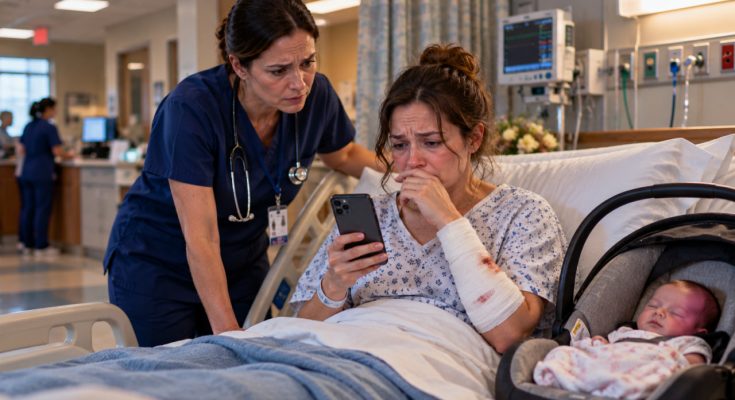
I thought about standing beside Ava’s carrier with seven stitches in my arm while my father explained why dinner mattered more.
And I realized something important.
Being capable of surviving without someone does not mean you never needed them.
I placed my folder on the table.
“I need you both to understand something,” I said. “I never expected you to give me money. I never expected you to buy my house or pay my bills. But I did expect you to care when I needed help.”
Dad looked uncomfortable.
“I do care.”
“Then why did you lie about Sophie?”
He opened his mouth.
I continued before he could answer.
“Why did you tell me she needed you when she had already told you she was staying home? Why did you decide that I could manage because I had a husband and a baby? Why did you assume that because my life looked stable, I no longer needed parents?”
Mom’s eyes filled with tears.
“Rachel, that isn’t what we meant.”
“Then what did you mean?”
For the first time, she had no immediate answer.
Sophie reached across the table and placed her hand over mine.
Then she turned toward our parents.
“I need to tell you something, too. I appreciate every time you helped me. I really do. But I don’t want a future that depends on you believing I’m incapable of standing on my own. I don’t want money that comes with the expectation that I must always be the daughter who needs rescuing.”
Dad stared at her.
“We never said that.”
“You didn’t have to,” she replied. “You kept treating me that way even after I got better.”
She took a breath.
“And I don’t want the house if the reason I’m getting it is that Rachel is being punished for being independent.”
Nobody spoke.
Then Dad closed the folder.
“I think you’re both misunderstanding the situation.”
“Then explain it,” I said.
He looked at Mom.
She looked away.
And finally, after a silence that seemed to stretch across the entire room, Dad admitted something neither of us had expected.
“Your mother and I have been arguing about money for months.”
I sat back.
“What?”
He rubbed his forehead.
“We have different ideas about retirement. Your mother wants to make sure Sophie has enough support because she worries Sophie will be alone in the future. I think we should divide our assets more evenly.”
Mom’s head snapped toward him.
“That isn’t fair.”
“Neither is pretending this has nothing to do with Sophie,” Dad replied.
The two of them began arguing, not loudly, but with the exhausted frustration of people who had been avoiding the same conversation for too long.
Mom insisted that Sophie might need more support later.
Dad argued that I had already been excluded from too many family decisions.
Then Mom said something that made Sophie go completely still.
“I promised your grandmother I would always look after Sophie.”
I frowned.
“Grandma?”
Our maternal grandmother had died when Sophie was sixteen. She had loved both of us, but she had been especially worried about Sophie during her difficult teenage years.
“What promise?” Sophie asked.
Mom’s eyes filled.
“Before she died, your grandmother told me she was worried Sophie would struggle without someone looking after her. She asked me to make sure Sophie would always have a safety net.”
Sophie stared at her.
“Grandma never told me that.”
“She told me privately.”
“Then why did you never tell me?”
Mom wiped her cheeks.
“Because I thought it was my responsibility to honor her wishes.”
Dad leaned back in his chair.
“Your mother took that promise too far. Every time Sophie encountered a problem, she believed she had to solve it. Every time Rachel handled something herself, she believed Rachel didn’t need anything.”
Mom didn’t deny it.
She looked at me through her tears.
“I thought I was doing the right thing.”
I wanted to be angry.
Part of me was.
But I could also see how a promise made in grief had become an excuse that neither parent had known how to release.
They had mistaken protection for love.
They had mistaken dependence for closeness.
And they had mistaken silence for proof that everything was fine.
Still, understanding the reason did not erase the damage.
I took a breath.
“Mom, I understand why you wanted to protect Sophie. But you can’t protect one daughter by teaching the other that she doesn’t matter.”
She began to cry harder.
“I never wanted you to feel that way.”
“But I did.”
Those four words were the hardest I had ever said to her.
Not because they were complicated.
Because they were true.
The conversation lasted another two hours.
We did not settle every financial question that afternoon. The attorney would need to review the proposed arrangements, and our parents would have to make their own decisions about their property and retirement.
But Sophie made one thing clear.
She would not accept a special inheritance simply because our parents believed she was too fragile to manage her own life.
And I made something else clear.
I would no longer pretend that unequal treatment didn’t hurt just because I could afford to live without their money.
Before we left, Dad asked if we could have dinner together the following Sunday.
I hesitated.
Sophie looked at me, leaving the decision to me.
Finally, I said, “We can have dinner. But I need you to understand that one conversation won’t fix everything.”
Dad nodded slowly.
“I understand.”
“I’m not asking you to make up for every mistake you’ve made. I’m asking you to stop deciding what I need without asking me.”
He looked down at his hands.
Then he said, “I’m sorry I didn’t come to the hospital.”
It wasn’t a grand apology.
He didn’t explain himself or blame the circumstances.
For the first time since the accident, he simply acknowledged what he had done.
I nodded.
“Thank you.”
Mom approached Sophie and asked if she could hug her.
Sophie agreed.
Then Mom turned to me.
I let her hug me, too.
But when I walked out of that house, I didn’t feel that everything had suddenly become wonderful.
I felt something more realistic.
I felt that a door had opened a few inches.
Whether it would stay open depended on what happened next.
Over the following months, things changed slowly.
Mom stopped sending Sophie money every month. Sophie had a stable income and wanted to manage her own finances. Our parents agreed to review their estate plans with their attorney, making decisions based on their wishes rather than assumptions about which daughter was more deserving or more vulnerable.
They did not promise us equal amounts of money.
We didn’t demand it.
What we asked for was honesty.
Dad also began making a genuine effort to call me without needing a reason. Sometimes he asked about Ava. Sometimes he asked how I was recovering. At first, our conversations felt stiff, as though we were both learning a language we should have known for years.
Mom began visiting on weekends.
She brought food, folded laundry when I asked, and learned to ask before taking over.
The first time she arrived and said, “Rachel, what would actually help you today?” I nearly cried.
Not because she had offered anything extraordinary.
Because she had finally asked.
Sophie and I grew closer, too.
We started having lunch together once a month. We shared photographs of our childhood and laughed about the ridiculous things we had done growing up.
She told me about her promotion, her friends, and her plans to travel.
I told her about the difficult nights of new motherhood, the fear I sometimes felt when Ava cried and I couldn’t immediately figure out why, and the guilt I experienced whenever I needed a break.
Neither of us pretended to be stronger than we was.
We were simply two sisters learning to know each other again.
One afternoon, about four months after my accident, Sophie came over carrying a small gift bag.
Inside was a silver frame containing a photograph taken at the hospital on the night she helped me get home.
It showed her holding Ava while I sat beside them, my injured arm resting in a sling.
I laughed when I saw it.
“We look exhausted.”
“We were exhausted.”
“You look like you haven’t slept in a week.”
“I hadn’t,” she replied. “You were the one who had just given birth.”
We both laughed.
Then I noticed the small inscription Sophie had placed beneath the photograph.
For the night we stopped being the daughters our parents expected us to be and started being sisters again.
I looked up at her.
“That’s beautiful.”
She smiled.
“I meant every word.”
I put the photograph on the mantel beside the old picture of us at the summer fair.
For years, I had believed the greatest proof of love was being the person who never needed anything.
I had tried so hard to be dependable that I had almost convinced myself I didn’t deserve to depend on anyone.
But that night in the hospital had taught me something I wished I had understood much earlier.
Independence should never be the price you pay for being loved.
My parents had made mistakes. Some of those mistakes had hurt deeply, and there were still moments when old feelings returned.
Forgiveness didn’t erase those memories.
It simply allowed us to decide what we wanted to do with them.
My father couldn’t change the night he refused to help me.
My mother couldn’t undo the years of assumptions that had divided her daughters.
But they could change what they did next.
And so could I.
I stopped measuring my worth by how little I asked for. I stopped automatically saying everything was fine when it wasn’t. I learned that asking for help didn’t make me weak, and setting boundaries didn’t make me cruel.
Most importantly, I stopped believing that I had to compete with my sister for the right to be cared about.
Because Sophie had never been my enemy.
We had both been children trying to understand a family that had quietly assigned us different roles.
And when we finally compared our experiences, we discovered that the truth was more complicated than either of us had imagined.
A year after the accident, we celebrated Ava’s first birthday at our apartment.
Mrs. Palmer came with a small stuffed rabbit. Sophie brought a cake decorated with yellow flowers. Dad arrived carrying a bag of groceries because he had insisted on helping with the preparations.
Mom spent the afternoon holding Ava while Ethan took photographs.
At one point, I watched my father standing in the kitchen beside Sophie, asking her about her new job.
He was listening.
Actually listening.
Then he turned toward me.
“Rachel, do you need anything?”
It was such a simple question.
For a second, I felt the old instinct rise inside me.
No, I’m fine.
But I looked around at the people in my apartment, at my daughter laughing in her grandmother’s arms, at my sister setting plates on the table, and at my husband smiling from across the room.
Then I answered honestly.
“Could you help Ethan bring the extra chairs upstairs?”
Dad smiled.
“Of course.”
And he did.
That evening, after everyone had gone home and Ava was finally asleep, I opened the silver frame Sophie had given me and looked at the photograph one more time.
I thought about the woman I had been that night in the hospital, frightened and injured, apologizing for needing something as ordinary as help.
I wished I could reach back through time and tell her something.
I wished I could tell her that she wasn’t difficult.
She wasn’t selfish.
She wasn’t asking for too much.
She was a daughter who needed her parents.
And that was never something she should have had to apologize for.
My parents’ refusal had revealed a painful truth about our family, but it had also brought Sophie and me back to each other.
I couldn’t change what happened.
I could, however, choose what happened afterward.
So I placed the photograph back on the mantel, turned off the living-room light, and went to check on my daughter.
Ava was sleeping peacefully, one tiny hand curled beside her cheek.
I kissed her forehead and whispered the promise I wanted her to grow up believing.
“You will never have to prove that you’re strong enough to deserve our love.”
And for the first time in a very long time, I believed those words completely.



One Comment on “PART 5 – My Parents Refused to Help Me After 7 Stitches—Then My Sister Replied to One Text and Exposed Their Lie”