PART 5
I bought a small tree.
I placed Ronald’s old wooden angel at the top.
I wrapped presents for the children and put them in a box in the spare bedroom.
I didn’t know whether Amanda would bring them to see me.
I hoped she would.
On December 10, Clare called.
“Grandma?”
“Hello, sweetheart!”
“Can I ask you something?”
“Of course.”
“Are you still making Christmas cookies?”
I smiled.
“Absolutely.”
“Can I come over and help?”
My heart lifted.
“Whenever you want.”
She became quiet.
Then she asked, “Can Wyatt and Hazel come too?”
“Of course. All three of you.”
“Mom says you might not want us anymore.”
I closed my eyes.
I had hoped Amanda would stop involving the children.
“Clare, listen to me. I love you, Wyatt, and Hazel. Nothing that happens between adults changes that.
You are never responsible for making things better between your mother and me.”
She sniffled.
“Okay.”
“And sweetheart?”
“Yes?”
“I have your favourite chocolate chips.”
She laughed.
It was the first time I had heard her laugh in weeks.
On December 17, Amanda finally called.
Her voice was different.
Not angry.
Not demanding.
Just tired.
“Mom, can we talk?”
“Yes.”
She asked whether she could come over on Saturday.
I agreed.
When Saturday arrived, she came alone.
She sat in the living room, looking at the Christmas tree.
For a while, neither of us spoke.
Then she said something I hadn’t expected.
“We’re in trouble, Mom.”
I sat opposite her.
“What kind of trouble?”
She looked down at her hands.
“Corey’s business has been losing money. We owe more than I realized.”
I waited.
She explained that the business had taken on several projects that required materials to be purchased upfront.
Two clients had delayed payments.
Another had canceled a contract.
The business still had some money coming in, but not enough to cover everything.
Their household expenses had become difficult to manage.
The $500 I had been sending each month had become part of their financial plan.
And when I stopped, the situation had become worse.
“Why didn’t you tell me?” I asked.
She looked at me.
“Because I was embarrassed.”
That was the first honest thing she had said in months.
I softened my voice.
“Amanda, I would have listened.”
“I know.”
“Why did you bring a real estate agent here?”
She looked away.
“Corey thought if we could convince you to sell the house, we might be able to solve everything.”
“And you agreed?”
She nodded slowly.
“I thought you would eventually say yes.”
I looked at her.
“Why?”
She began crying.
“Because you always helped us.”
I sat quietly.
Then I said something I had wanted her to understand for a long time.
“Helping you was never the problem, Amanda. The problem was that you stopped asking whether I wanted to help. You began making decisions as if my time, my money, and my home were already yours.”
She covered her face.
“I know.”
“No, sweetheart. I don’t think you do.”
She looked up.
I continued.
“When your father died, I was terrified. I had lost the person I had spent most of my adult life with. I was learning how to live alone. I gave you that emergency key because I wanted to know someone could reach my house if something happened to me.”
My voice trembled.
“I never imagined that one day I would watch my own daughter use it to enter my home against my wishes.”
Amanda began crying harder.
“And when you told me I might not see my grandchildren unless I started sending money again, that hurt more than you know.”
She shook her head.
“I shouldn’t have said that.”
“No. You shouldn’t have.”
We sat in silence.
Then she asked, almost in a whisper:
“Can you forgive me?”
I looked at her.
I loved my daughter.
I had never stopped.
But forgiveness didn’t mean pretending nothing had happened.
“I can forgive you, Amanda. But things cannot return to the way they were.”
She nodded.
“What does that mean?”
“It means you need to understand that I am not your financial safety net. You and Corey must manage your household. If you need advice, I can listen. If the children need something reasonable, we can discuss it. But I will not give you money simply because you have built your budget around receiving it.”
She wiped her eyes.
“And the house?”
“The house stays mine.”
She nodded.
“I understand.”
I hoped she meant it.
Christmas Eve arrived.
For the first time in several years, I didn’t host a large family gathering.
Instead, I prepared a small dinner.
Roast chicken.
Mashed potatoes.
Green beans.
Homemade stuffing.
And, of course, pumpkin pie.
At four o’clock, someone knocked.
I opened the door.
Clare stood there holding a small gift.
Behind her were Wyatt and Hazel.
Amanda was standing beside the SUV.
My grandchildren ran toward me.
“Grandma!”
I bent down and wrapped my arms around them.
For several minutes, I couldn’t speak.
I simply held them.
Then Amanda approached.
“Hi, Mom.”
“Hello.”
She looked nervous.
“We brought something.”
She handed me a small wrapped box.
Inside was a framed photograph.
It showed Ronald sitting in the backyard with Amanda and Seth when they were children.
I remembered the day.
It had been a warm summer afternoon.
Ronald had been teaching them how to build a birdhouse.
On the back of the frame, Amanda had written:
“Thank you for always being our home.”
I looked at her.
She was crying again.
“I’m sorry,” she whispered.
I put the photograph on the table.
Then I hugged her.
Not because everything was fixed.
Not because I had forgotten what happened.
But because I wanted to leave room for something better.
Over the next few months, things slowly changed.
Amanda and Corey met with a financial adviser.
They reviewed their household spending and decided to sell the Highlander and replace it with a less expensive vehicle.
Corey reduced the size of his business operations and focused on smaller, more manageable contracts.
They also refinanced some of their debt without involving my property.
It wasn’t easy.
There were arguments.
There were difficult conversations.
But they began taking responsibility for their own decisions.
Amanda returned to visiting me with the children on Sundays.
At first, she was careful.
She asked before bringing anyone.
She called before arriving.
And she never mentioned the $500 again.
I also made a change.
I stopped automatically paying for everything whenever the grandchildren visited.
Instead, I enjoyed spending time with them.
We baked cookies.
We played board games.
We went to the park.
I learned that being a grandmother didn’t require me to finance an entire household.
It simply required me to love my grandchildren.
One afternoon in April, Amanda came over while the children were playing in the backyard.
She helped me clear some old branches from the garden.
After a while, she sat beside me on the patio.
“Mom?”
“Yes?”
“Can I ask you something?”
“Of course.”
She looked at the garden.
“Do you think Dad would be disappointed in me?”
I stopped what I was doing.
It was the first time she had mentioned Ronald since Christmas.
“Why do you ask?”
“Because I keep thinking about how he used to help everyone.
He never made us feel like we were asking too much.”
I smiled sadly.
“Your father loved helping people. But he also believed people should learn to stand on their own feet.”
Amanda nodded.
“He would probably have told me to stop expecting you to solve everything.”
I laughed softly.
“Probably.”
She smiled for the first time.
Then she became serious again.
“I think I forgot that you’re not just my mother.”
I looked at her.
“Who am I, then?”
She took my hand.
“You’re Joyce. You’re a person. You have your own plans, your own money, your own life. And I should have respected that.”
I squeezed her hand.
“Yes, sweetheart. I am.”
She leaned her head against my shoulder.
For a while, we watched the children running around the garden.
I thought about the woman I had been the previous November.
The woman who sat alone at the cottage, wondering whether her daughter would ever understand.
The woman who had spent years believing that saying no meant disappointing someone.
I had learned something important.
A mother can love her children without surrendering everything she owns.
A grandmother can adore her grandchildren without paying for their parents’ lifestyle.
And a widow can build a peaceful life without asking permission from anyone.
A year later, Thanksgiving came around again.
This time, Amanda called me in September.
“Mom, what are your plans for Thanksgiving?”
I smiled.
“I’m thinking of going to the cottage for a few days.”
“That sounds lovely.”
There was a pause.
Then she asked:
“Would you like to come to our house for dinner on Sunday? We’re hosting this year. Nothing enormous. Just the family.”
I laughed.
“Are you sure you want to cook?”
“Yes. I’ve been practicing your stuffing recipe.”
“Well, that’s ambitious.”
She laughed.
“And Mom?”
“Yes?”
“You don’t have to bring anything.
Just come if you want to.”
I looked toward the window.
The maple tree in my backyard had turned golden.
“Thank you, Amanda. I’d love to come.”
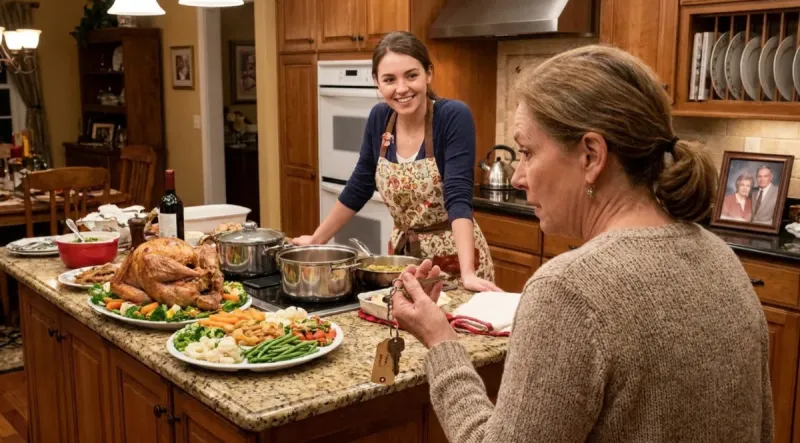
On Thanksgiving Sunday, I arrived at their house at five o’clock.
Their kitchen was warm and full of activity.
Corey was carving the turkey.
Wyatt was setting the table.
Hazel was arranging flowers.
Clare was making gravy.
Amanda stood in the middle of it all, wearing an apron and looking slightly overwhelmed.
When she saw me, she smiled.
“Mom! You’re here.”
I put my coat away.
“Of course.”
She pointed toward the kitchen.
“Everything is almost ready.”
I looked at the counter.
There were potatoes, vegetables, stuffing, rolls, and two pies.
“Looks wonderful.”
Then she leaned closer and whispered:
“I almost burned the stuffing.”
I laughed.
“That means you’re doing it properly.”
We both laughed.
For the first time in a long time, I felt like I was simply visiting my daughter’s home.
Not working for her.
Not paying for her.
Not rescuing her.
Just being her mother.
During dinner, Clare raised her glass.
“I want to say something.”
Everyone looked at her.
“I’m thankful that Grandma comes to visit us. And I’m thankful that Mom and Grandma are getting along again.”
Amanda reached for my hand beneath the table.
I squeezed it.
After dinner, Corey helped clear the plates.
Nobody expected me to wash everything.
Nobody asked me to pay for the groceries.
Nobody treated my home or my money as something they could claim.
It was just a family dinner.
And that was all I had wanted.
A few days later, I returned to my cottage.
I sat on the porch with a cup of coffee and looked out over the quiet lake.
The trees were nearly bare.
A cold breeze moved across the water.
I thought about Ronald.
I wished he could have seen our family that evening.
I wished he could have heard the children laughing.
But I also knew he would have been proud of me for finally learning something that had taken me far too long to understand.
Love should never require you to disappear.
Being generous should never mean surrendering your independence.
And saying no does not make you a bad mother.
I had spent much of my life believing that keeping everyone happy was my responsibility.
I now understood that it wasn’t.
My daughter had needed to learn that my home was not hers to enter whenever she pleased, my money was not hers to expect, and my future was not hers to arrange.
But I had needed to learn something too.
I could love Amanda without allowing her to control my life.
I could forgive her without pretending she had done nothing wrong.
And I could welcome my grandchildren without buying their affection.
I finished my coffee and went inside.
Before closing the door, I looked once more at the lake.
For the first time in years, I felt completely at peace.
My name is Joyce.
I am sixty-five years old.
I am a mother, a grandmother, and a widow.
But most importantly, I am still my own person.
And that house in Peterborough?
It is still mine.
Not because I want to keep something from my children.
But because I spent thirty-two years building a home, and I deserve to decide what happens to it.
I didn’t lose my family when I finally learned to say no. I simply discovered who was willing to love me even when I stopped saying yes.

One Comment on “PART 5 – My Daughter Tried to Sell My $700,000 House Without My Permission—But She Never Expected Her Own Mother to Say NO”