PART 7
“We can fix this.”
I closed my eyes.
“How?”
“We’ll drop everything.”
“Everything?”
“Yes.”
“The house?”
“Yes.”
“The money?”
Silence.
My father didn’t answer.
I knew then.
They were willing to give me my home because they had already lost the argument.
But they weren’t willing to return my daughter’s money.
“You don’t get to decide what happens next,” I said.
Then I hung up.
The following week changed everything.
The financial investigation uncovered more than we expected.
My mother had been communicating with an attorney about establishing herself as a temporary financial guardian for Norah.
Her stated reason?
That I was allegedly “financially unstable.”
The evidence they planned to use included the renovation expenses for the carriage house.
They had deliberately taken the money I had spent repairing the property and described it as evidence that I was “reckless with finances.”
I stared at the report.
They had taken the sacrifices I had made for my daughter and tried to turn them into proof that I was a bad mother.
That hurt more than the money.
Much more.
But then came the final discovery.
Ava had been right.
My mother had created a private spreadsheet listing every asset she believed I owned.
Savings.
Investments.
Property.
Insurance.
Norah’s trust.
Everything.
Beside each asset was a note.
Possible transfer.
Possible control.
Needs legal review.
My mother hadn’t been trying to help Ava get a home.
She had been planning how to gain control over my finances.
And the carriage house was simply the first thing she thought she could take.
When I read that document, something inside me finally became quiet.
I stopped asking myself why.
I stopped wondering whether I had misunderstood them.
I stopped hoping they would apologize.
There are moments when a person doesn’t become stronger because someone gives them strength.
They become stronger because they finally stop giving their strength away.
That was my moment.
The hearing regarding the financial investigation took place six weeks later.
This time, I walked into the courthouse differently.
I wasn’t terrified.
I wasn’t trying to prove I deserved my home.
I was there to protect my daughter.
My parents sat across the room.
My father looked older.
My mother looked angry.
Ava sat alone behind them.
When she saw me, she stood.
“Can I talk to you?”
I nodded.
She came closer.
“I gave the attorney everything I had.”
I looked at her.
“What do you mean?”
“The emails. The messages. The spreadsheet.”
I was quiet.
She continued.
“I know it doesn’t fix what I did.”
“No,” I said.
“It doesn’t.”
She nodded.
“I know.”
There was a long silence.
Then she said:
“I don’t expect you to forgive me.”
I looked at her.
“But I hope someday you can.”
I didn’t promise.
Instead, I said:
“Maybe.”
She nodded.
“That is more than I deserve.”
Then she walked away.
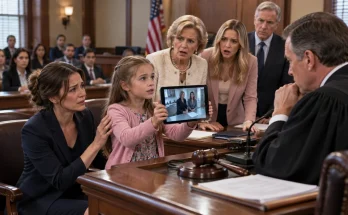
Inside the courtroom, the judge reviewed the evidence.
The handwriting expert confirmed that the signature on the power-of-attorney form had not been written by me.
The bank records showed the unauthorized transfers.
The emails showed my mother had discussed using the funds for legal expenses connected to the property dispute.
The spreadsheet showed her plans to obtain control over my finances.
And the original agreement proved my father had given me permission to occupy the carriage house for as long as Norah and I needed a home.
The judge listened to everything.
Then he looked at my parents.
“Mr. and Mrs. Harrison, this court is deeply concerned by the evidence presented.”
My mother looked down.
The judge continued.
“The issue before the court is no longer merely a disagreement over property.”
He paused.
“It concerns financial authorization involving a minor’s protected assets.”
My father whispered something to my mother.
She didn’t answer.
The judge ordered the remaining funds in Norah’s trust frozen and transferred to an independent fiduciary account.
He ordered my parents to return the money that had been improperly withdrawn.
He also dismissed the eviction claim permanently.
Then came the part none of us expected.
The judge referred the suspected forged authorization to the appropriate authorities for further investigation.
My mother closed her eyes.
My father sat completely still.
I looked at Norah.
She was holding my hand.
She didn’t understand all the legal words.
She didn’t need to.
She only knew that we were going home.
Months passed.
The investigation continued.
My parents eventually reached a civil settlement requiring them to repay the money, relinquish any claim to the carriage house, and cover the legal expenses I had incurred.
They also signed an agreement acknowledging that the property was not available for Ava’s use.
My father apologized.
Not in court.
Not in a letter.
He came to my house one afternoon and stood on the porch.
He looked at the flowers Norah had planted.
“I was wrong,” he said.
I didn’t answer immediately.
He looked at the front door.
“I kept telling myself I was helping the family.”
I looked at him.
“You were helping yourself.”
He nodded.
“I know.”
For once, he didn’t argue.
He didn’t make excuses.
He simply stood there.
“I don’t expect you to forgive me,” he said.
“I don’t know if I can.”
“I understand.”

One Comment on “PART 7”